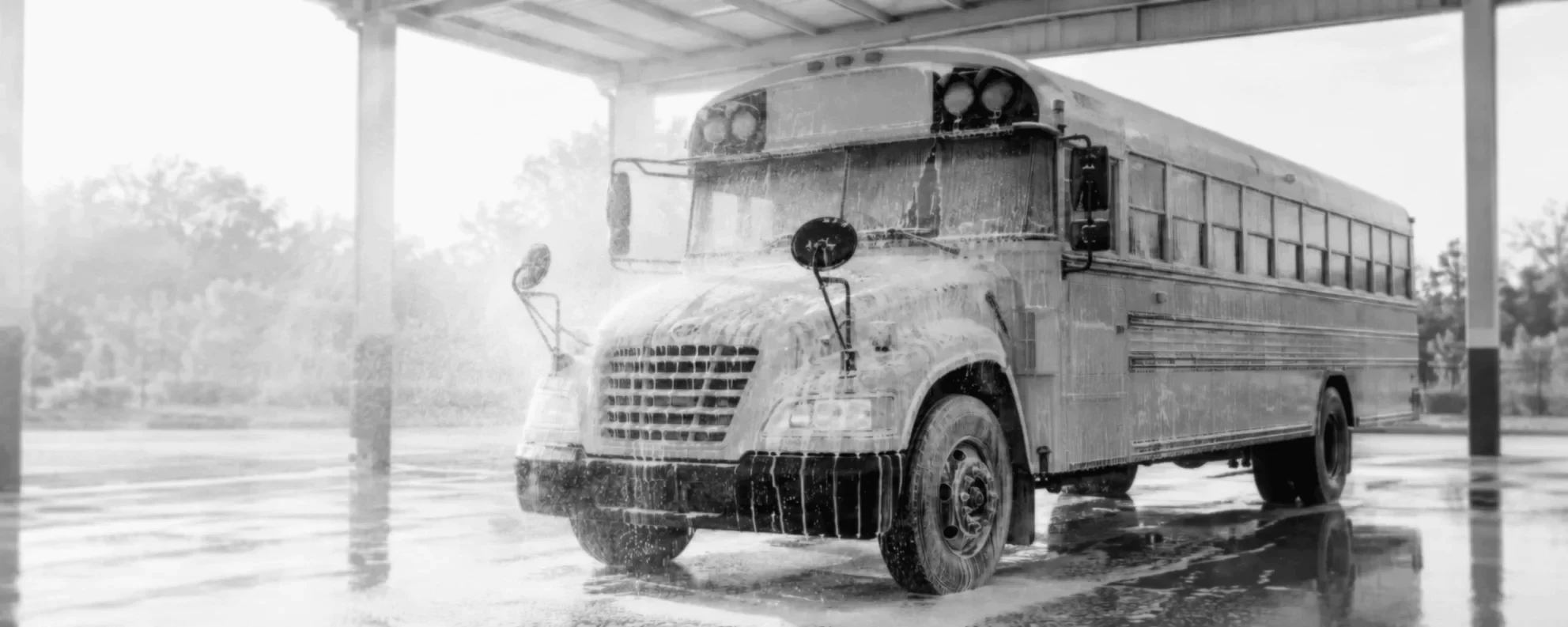
Consider a service truck with a chalky hood, a faded cab roof, and years of visible wash damage. One person may recommend polishing. Another may recommend repainting. Both are looking at the same vehicle, and neither recommendation is reliable until the finish has been properly cleaned, inspected, and tested.
Why It Matters
Fleet appearance is often treated as separate from maintenance, but the exterior finish serves more than a decorative role.
A coating system helps protect metal, fiberglass, composites, and other substrates from weather, moisture, contamination, chemicals, and ultraviolet exposure. It also supports graphics, reflective markings, cleaning, inspection, resale, public presentation, and long-term asset preservation.
Weathering changes coatings chemically and physically. Research on polyurethane-based coatings has modeled photo-degradation, surface erosion, increasing roughness, gloss loss, and changes in fracture toughness as related parts of the aging process. [1]
That distinction matters because dullness is not one condition. Contamination, shallow defects, oxidation, and material failure can all reduce gloss, but they do not call for the same response.
A fleet that assumes every dull surface needs paint may spend more than necessary. A fleet that assumes every faded surface can be polished may remove material from a finish that should instead have been protected earlier or evaluated for professional refinishing or repainting.
Begin by Identifying the Finish
Fleet vehicles do not all use the same paint system.
Even within one organization, the fleet may include single-stage paint, basecoat with clear coat, factory-applied baked finishes, commercial polyurethane systems, previous collision repairs, spot repairs, repainted panels, fiberglass or composite panels, powder-coated components, decals and wraps, painted aluminum, painted steel, and plastic components with their own coating systems.
A single-stage finish combines color and surface protection within the pigmented topcoat. When that finish is polished, some pigmented material may transfer to the polishing pad because the color-bearing layer itself is being worked.
In a basecoat and clear coat system, those functions are separated. The basecoat provides color and effect, while the clear coat forms the outer weathering and wear surface. Correction removes or levels a small portion of that clear layer, not the color layer beneath it.
Both systems can sometimes be corrected.
Both systems can also reach a point where additional polishing is no longer appropriate.
The practical difference is what material is being removed and how much usable coating remains afterward.
What the Existing Finish Can Still Support
Correction is appropriate only when the existing coating remains bonded, sufficiently intact, and capable of continued service after the work is completed.
The evaluator must distinguish defects located on or within the upper portion of a usable finish from conditions caused by adhesion loss, material depletion, corrosion, or substrate damage.
The decision is therefore not based on whether visible improvement is possible. It is based on whether the remaining finish can support that improvement responsibly.
Recoverable Surface Conditions
Recoverable conditions generally fall into three groups.
Surface defects include wash-induced swirl marks, shallow scratches, surface haze, uneven gloss after prior polishing, and light transfer from another object.
Environmental contamination includes embedded fallout, mild staining, overspray, and mineral deposits that have not deeply etched the finish.
Weathering-related conditions include light oxidation, loss of gloss, and visible dullness concentrated in the upper portion of an otherwise stable coating.
For a working fleet vehicle, the objective is usually a meaningful and uniform improvement that preserves as much usable coating as possible, not a flawless finish.
The work should match the asset, its role, its remaining service life, and the budget.
When Oxidation Remains Correctable
Oxidation is often used as a broad description for any faded or chalky surface, but it exists on a spectrum.
Early weathering may affect the uppermost portion of the coating. The surface becomes less smooth, reflects light less evenly, and loses depth. Controlled correction may remove or refine the degraded material and reveal a more uniform layer beneath it.
More advanced oxidation can affect a greater portion of the available film. The surface may release heavy pigment, remain uneven after repeated polishing, stain easily, or lose gloss again quickly.
At that stage, improvement may still be possible. The more important question is whether enough stable coating remains to justify correction.
The fact that a surface becomes brighter does not establish that the result will remain uniform, durable, or appropriate for fleet-wide work.
Conditions Correction Cannot Repair
Polishing cannot restore coating that is no longer present.
It cannot permanently repair peeling or delaminating clear coat, exposed primer or substrate, deep cracks, checking, severe crazing, widespread loss of adhesion, corrosion beneath the coating, failing previous repairs, or broad film failure.
Correction can make some of those conditions look better temporarily, but appearance is not the same as a durable repair.
A failing clear coat can become shinier around the damaged area while delamination continues. A corroding panel may look cleaner while the corrosion remains untouched.
This is why the inspection must answer more than, “Can we make it shine?”
The more important question is, “Will the remaining finish still perform after the work is completed?”
Two Similar Vehicles, Two Different Decisions
Consider two similar white school buses parked beside one another. From twenty feet away, both appear uniformly faded.
After washing and inspecting the first bus, a small test section regains substantial gloss with a mild polishing process. The improvement is even, the finish remains stable, and the required result can likely be repeated across the vehicle without excessive material removal.
The second bus immediately releases heavy pigment during testing. Its finish remains blotchy after controlled polishing, and the improvement begins to diminish as residue is removed. Although the surface can be made temporarily brighter, the remaining coating does not appear stable enough to justify fleet-wide correction.
From a distance, the buses presented the same problem. Testing revealed that only one of them had a finish worth correcting.
Testing Should Guide the Decision
Visual appearance alone cannot establish whether a finish should be corrected or repainted.
A controlled test section, supported by measurement where the substrate and instrument allow it, reveals how the surface responds and whether the result can be repeated responsibly.
The Test Section
A controlled test can reveal how quickly the finish responds, how uniformly gloss returns, whether pigment transfers to the pad, and which defects remain after correction.
It can also establish how much labor the process requires, whether the result justifies the cost, and whether the same improvement can reasonably be repeated across similar panels or vehicles.
The test should begin with the least aggressive reasonable method. If a light polish provides the required improvement, a heavier compound may remove unnecessary material.
If multiple aggressive passes are required to create only a small improvement, the remaining finish may not support a fleet-wide correction process.
The test area should be evaluated after oils and polishing residue have been removed because temporary filling or darkening can exaggerate the result.
A durable assessment requires a clean surface, honest lighting, and enough time to evaluate the actual finish.
Gloss Is Evidence, Not a Verdict
Gloss can be evaluated visually and, where useful, measured instrumentally.
ASTM D523-25 provides standardized methods for measuring specular gloss at defined geometries. A gloss reading can help document initial condition, compare test sections, and measure consistency across a group of vehicles. [2]
A gloss number does not determine whether a surface should be corrected or repainted. It records one property of the finish, not its adhesion, thickness, substrate condition, or remaining service life.
Film Thickness Provides Context
Paint-thickness measurement can be useful, but the number must be interpreted correctly.
A reading can help identify unusually thin areas, previous repairs, repainted panels, inconsistent application, high-risk edges, and differences between adjacent panels.
The reading usually does not reveal the exact remaining thickness of the clear coat by itself. A total measurement may include primer, surfacer, color, clear coat, and previous refinishing layers.
Composite and fiberglass panels may require different equipment or may not provide a useful reading with a basic gauge.
Edges, body lines, raised features, rivets, panel transitions, repaired areas, and high points may have less usable material than broad flat sections.
Film-thickness measurement should support professional judgment, not replace identification, inspection, or testing.
Adhesion Changes the Entire Decision
A glossy coating can still have poor adhesion.
If the finish is separating from the layer beneath it, polishing will not restore the bond.
Signs of adhesion failure may include peeling, lifting edges, flaking, blistering, delamination around chips, failure along repair boundaries, coating loss during washing, and separation around decals or seams.
ASTM D3359-23 describes tape-test methods used to rate coating adhesion in appropriate applications. Such testing can damage the surface, depends on trained and consistent technique, and should not be performed casually on an in-service vehicle. [3]
Gloss and adhesion are different properties.
When adhesion is questionable, a qualified refinishing professional should evaluate the coating system before any correction, ceramic protection, or refinishing work proceeds.
“A finish can look dull and remain well bonded. It can look shiny and still be failing underneath.”
Different Coating Systems Fail Differently
Fleet vehicles may use single-stage paint, basecoat with clear coat, commercial refinishing systems, painted composites, fiberglass, aluminum, steel, plastics, decals, wraps, and previous repairs within the same operation.
The same visible dullness can therefore represent very different conditions. The material being worked, the way it is failing, and the substrate beneath it determine what the surface can support.
Single-Stage Finishes Require a Different Expectation
Single-stage paint combines color and surface protection within the pigmented topcoat, so correction removes material from the color-bearing layer itself.
Some pigment transfer may be expected. Heavy transfer, rapid pad loading, uneven color, or a surface that remains porous and unstable may indicate more advanced deterioration.
Protected areas beneath decals, trim, mirrors, warning lights, or graphics may retain a deeper original color than exposed areas.
Correction can improve gloss without fully restoring uniform pigment or factory-new color.
A fleet manager should distinguish restored gloss, improved color depth, color uniformity, remaining film integrity, and expected durability.
Those are related outcomes, but they are not the same.
Clear Coat Failure Cannot Be Polished Back Into Place
Clear coat failure often begins subtly. The surface may appear cloudy, patchy, dry, or uneven before cracking, lifting, or separation becomes obvious.
Once the clear layer has lost adhesion or broken through, correction cannot recreate it.
Polishing around the failure may sharpen the contrast between intact and damaged areas or accelerate loss at the edge of the remaining coating.
A durable and uniform result requires refinishing when the clear coat can no longer serve as a stable outer layer.
The required scope may be limited to one panel, several panels, or the complete vehicle depending on the extent of failure, color match, repair history, graphics, adjacent condition, remaining service life, and budget.
The correct response is not automatically a complete repaint. Localized professional refinishing may be sufficient when the surrounding finish remains sound.
Corrosion and Substrate Damage Move the Job Beyond Correction
Paint correction addresses the surface of the coating. Corrosion and substrate damage begin beneath or through it.
Visible rust, bubbling, seam staining, lifting around fasteners, cracking near joints, and coating loss at damaged metal require investigation beyond polishing.
Fiberglass and composite panels may show cracks, exposed fibers, impact damage, delamination, or previous repair failure that requires structural or refinishing work.
A polished surface can conceal some visual evidence temporarily. It cannot repair the material beneath it.
Inspection should include seams, rivets, fasteners, roof penetrations, panel edges, body mounts, wheel openings, step areas, lower panels, door openings, previous repair zones, and locations where water or chemicals collect.
The condition of the substrate sets the outer limit of what appearance correction can accomplish.
Repainting Is a System, Not a Color Application
Professional repainting involves more than applying new color.
The process may require removal of loose or failed coatings, cleaning, sanding, feathering, corrosion treatment, substrate repair, filling and surfacing, compatible primers, color application, clear coat where required, controlled curing, masking, graphics work, and final inspection.
The new material must be compatible with the substrate and any coating that remains beneath it. If a failing layer is left in place, the new finish may eventually separate with it.
Spray refinishing also introduces ventilation, fire-control, environmental, and worker-exposure requirements that differ substantially from polishing. Professional coating application belongs in an appropriately equipped environment with trained personnel and product-specific safety procedures. [4][5]
A fleet should not treat repainting as a larger version of detailing.
It is a specialized refinishing operation.
Correction, Protection, and Professional Refinishing Are Different Paths
Fleet managers may receive proposals that use similar language while offering fundamentally different scopes. A proposal should identify whether it refines the existing finish, protects a viable finish, or repairs and rebuilds a failed coating system. Those are not interchangeable services.
Paint Correction
The existing viable finish is cleaned, mechanically refined, and polished to reduce correctable oxidation, haze, wash damage, and shallow defects. No new paint system is added, and the process must preserve enough usable material for continued service.
Ceramic Protection
A professional ceramic coating is applied over a properly prepared, viable existing finish to support gloss retention, contamination resistance, and easier routine care. Ceramic protection cannot stabilize peeling, poorly bonded, corroded, exposed, or materially depleted paint.
Professional Refinishing or Repainting
When adhesion failure, exposed substrate, corrosion, color-layer failure, widespread damage, or material loss has compromised the coating system, a qualified refinishing facility must repair or rebuild it. Alpine ceramic protection may be considered only after the refinished surface is suitable and sufficiently cured.
Fleet-Level Results Should Be Defined Before Work Begins
A correction project can exceed its budget quickly when it begins without a defined standard.
“Make it look better” is not specific enough.
The fleet should define the expected improvement in gloss, color consistency, visible wash damage, oxidation, high-visibility areas, graphics, and labor per vehicle.
The standard should also identify defects that will remain. Deep scratches, chips, color loss, previous repairs, cracked coatings, and substrate damage may fall outside the approved process.
The objective should match the asset, its role, and its remaining service life.
Documenting the result and its limits protects both the fleet and the service provider.
Start With the Most Valuable Areas
Complete-vehicle correction is not always the strongest use of the budget.
Hoods, front clips, cab roofs, upper body panels, horizontal fiberglass, doors, customer-facing sides, emergency-service markings, loading areas, and panels exposed to insects or road film may deteriorate faster than the rest of the vehicle.
A targeted program may correct and protect high-visibility or high-exposure areas, apply lighter enhancement elsewhere, and route failed panels toward refinishing.
This allows different processes to be used on the same vehicle according to actual condition.
Uniform packages are easier to administer. Condition-based scopes often make better use of the budget.
The Wash Process Determines Whether the Result Lasts
Correction removes or reduces existing defects. It does not prevent new ones.
If the vehicle returns to harsh brushes, contaminated wash media, unnecessarily aggressive chemicals, poor rinsing, or untrained washing practices, visible damage can return quickly.
Maintenance planning should define wash frequency, chemical strength, dilution, contact methods, brush or media condition, water quality, drying, contamination removal, protection, and periodic inspection.
A corrected finish is often easier to evaluate because general dullness no longer hides new defects or contamination.
The result should therefore be connected to a maintenance standard before the vehicle returns to service.
The best coating still depends on the condition beneath it and the care it receives afterward.
Preservation Should Begin Before Correction Is Needed
The most cost-effective correction is often the one the fleet never has to perform.
New and recently refinished vehicles provide the best opportunity to establish protection before visible oxidation and wash damage develop.
A preservation program may include documented delivery inspection, baseline photographs, paint-condition records, appropriate washing, rapid contamination removal, selected protective coatings, roof and seam review, annual condition assessment, and early repair of chips or damage.
This does not eliminate aging. It keeps more options available for longer.
A sound finish may be maintained and protected. A mildly weathered finish may be corrected. A failed finish must be rebuilt.
The earlier the fleet identifies the transition between those conditions, the more control it retains over scope, downtime, and cost.
The Right Decision Preserves the Asset
Paint correction and repainting are not competing services. They are different responses to different coating conditions.
Correction is appropriate when the existing finish remains bonded, stable, and substantial enough to improve without sacrificing the protection the vehicle still needs.
Repainting becomes necessary when material loss, poor adhesion, exposed substrate, corrosion, or widespread failure has removed that foundation.
The strongest decision is based on what the coating can safely support, how long the result should last, and whether the investment matches the vehicle’s remaining service life.
The goal is not to polish every faded vehicle or repaint every dull panel. It is to understand the finish before choosing either path.
Sources & Further Reading
- 1.Gupta, Ambesh; Maiti, Soumyadipta; Saini, Parvesh; Srivastava, Surabhi; Kausley, Shankar; and Rai, Beena. “Combined Concurrent Physical and Chemical Model for Accelerated Weathering Damages of Polyurethane-Based Coatings.” Physica Scripta 101 (2026), 145924.
- 2.ASTM International, ASTM D523-25, Standard Test Method for Specular Gloss.
- 3.ASTM International, ASTM D3359-23, Standard Test Methods for Rating Adhesion by Tape Test.
- 4.U.S. Environmental Protection Agency, National Emission Standards for Hazardous Air Pollutants applicable to paint stripping and miscellaneous surface coating operations at area sources.
- 5.Occupational Safety and Health Administration, 29 CFR 1910.107, Spray Finishing Using Flammable and Combustible Materials.
Related Field Notes
- Budget & Asset Management11-minute read
The Hidden Cost of Deferring Noncritical Maintenance
Not every postponed repair is a bad decision. This Field Note examines how minor defects, preservation needs, and lower-priority work can quietly increase cost, downtime, labor, and replacement pressure when they are no longer tracked.
- Fleet Planning12-minute read
Repair, Refurbish, or Replace?
A practical framework for determining whether the next fleet dollar should correct an isolated problem, restore broader useful life, or move the organization toward replacement.
- School Transportation10-minute read
How Long Should a School Bus Remain in Service?
Age and mileage are important, but they rarely tell the whole story. This Field Note examines the condition, cost, reliability, route demands, and replacement planning that should determine a school bus's true useful life.
From Alpine Fleet Coatings
Managing a working fleet in Georgia?
Alpine Fleet Coatings provides mobile exterior protection, preservation, and maintenance-washing services across Georgia. When your vehicles are ready for professional exterior care, we bring the equipment and process directly to your yard.