Clear, practical guidance for understanding what your vehicles need before choosing a service.
Surface protection is not one-size-fits-all. Paint condition, material type, prior repairs, sun exposure, wash history, graphics, and existing coating condition all influence the right path. This guide explains what Alpine evaluates, why different vehicles may need different solutions, and what questions to ask before scheduling work.
What This Guide Covers
What to Ask First
Where Each Service Fits
What to Expect
Technical Insight for Fleet Decision-Makers
The Technical Side of Fleet Protection, Made Clear
Fleet protection is not a single product or one-step process. Vehicle material, age, previous repairs, outdoor exposure, washing practices, and daily operating demands all affect which surface treatment makes sense and what the work can realistically accomplish.
The goal of this guide is to give fleet managers a practical look inside the evaluation process, explain how different systems work, and clarify when each service fits. The better the surface is understood, the better the recommendation becomes.
“Better fleet decisions begin with clear diagnostics and an honest understanding of the surface.”
Chapter 01 of 04
CHAPTER 01/Surface Damage
Understanding Fleet Surface Damage
Before any service is recommended, the surface itself has to be understood. A fleet vehicle is a layered system, not a single coat of paint, and the way that system has aged determines which paths can safely improve or protect it. This chapter covers how a fleet finish is actually built and how daily exposure reshapes it over time.
Section 1.1 · Surface Systems & Materials
A Fleet Vehicle Is a Layered Surface System
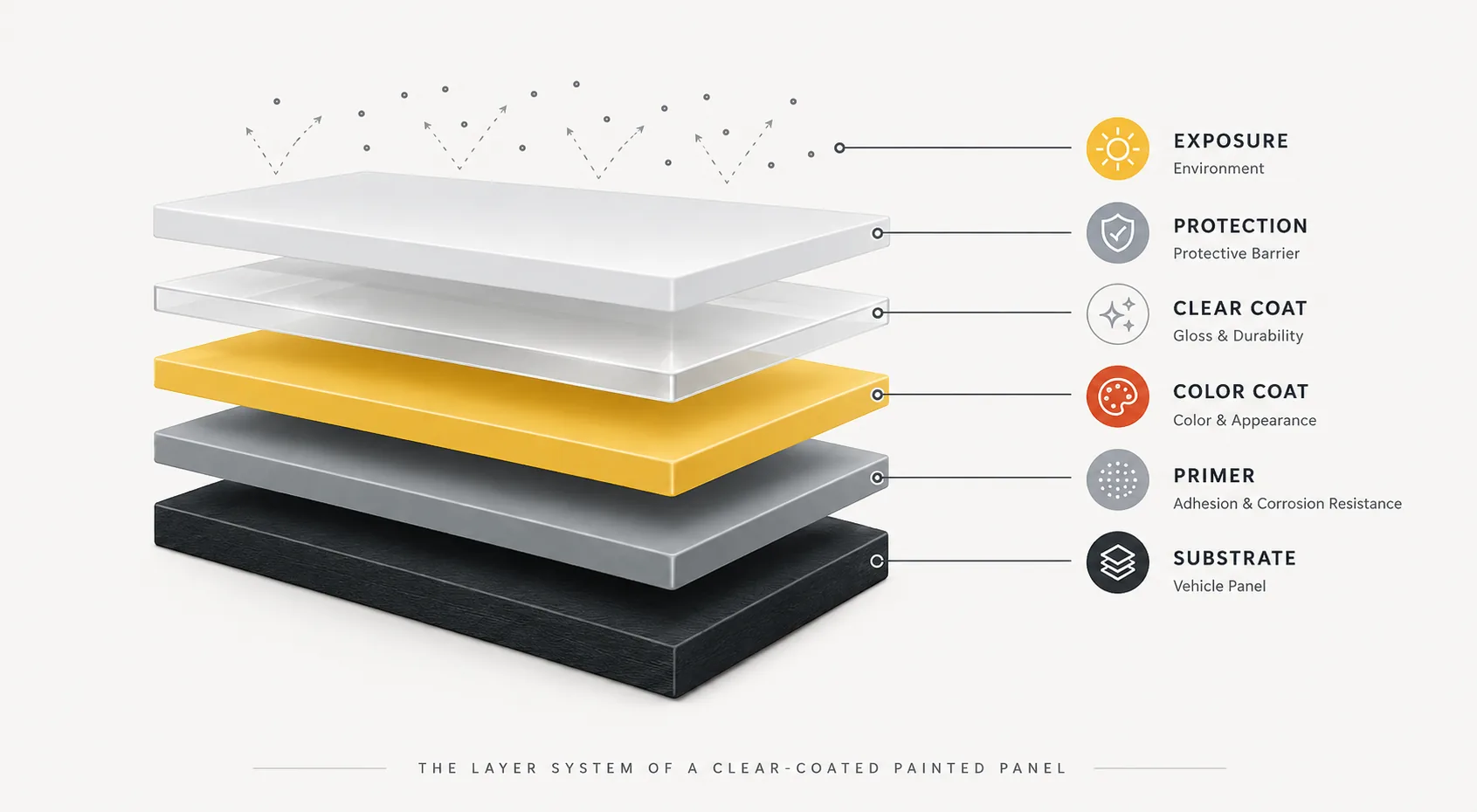
A fleet vehicle is not one surface. It is a layered system made up of substrates, primers, paint, clear coat, graphics, sealants, roof coatings, decals, and prior repairs. Each layer affects how the vehicle looks, how it ages, and which service can safely improve or protect it.
The most important question is not simply whether the surface looks dull, scratched, or faded. The real question is whether the surface is stable. Some defects can be corrected through polishing. Others signal coating failure, adhesion loss, or material breakdown and require a different service path. Alpine’s first job is to understand that difference before recommending work.
Two adjacent panels can look similar and still behave very differently. One may have healthy clear coat that can be corrected and protected. Another may have oxidation, previous repair work, or a failing finish that requires a more conservative approach. That is why the same recommendation rarely fits every panel or every vehicle, even within one fleet.
How the Layers Sit Together
The layer system of a clear coated painted panel.
A typical fleet vehicle is more than one painted surface. It may include painted steel body panels, aluminum components, fiberglass or composite hoods, plastic trim, vinyl graphics, reflective markings, sealants, and roof areas that may already have previous coatings or repairs.
Each surface responds differently to washing, correction, ceramic protection, roof preservation, and — when the finish has failed — professional refinishing or repainting. Deciding what to do starts with identifying what is actually on the vehicle, not just what the vehicle looks like from a distance.
A surface that looks the same can behave very differently once the system beneath it is understood.
01
Field Example · Two Similar Vehicles Can Require Different Service Paths
What you may notice. Two buses of similar age and color can look dull at first glance. After inspection, one may have correctable oxidation and intact clear coat. Another may have thin, failing, or previously repaired clear coat that will not safely respond to the same process.
Why it deserves attention. A visual match does not always mean a technical match. Treating both vehicles the same way can produce uneven results, unnecessary labor, or a finish that does not hold up.
What it may indicate. One roof or hood may only need cleaning, correction, and ceramic protection. Another may have progressed beyond what correction and protection can address and may require evaluation by a qualified refinishing facility.
Possible service direction. One vehicle may be a candidate for paint correction and ceramic protection. Another may require SummitX roof preservation, a maintenance-focused wash plan, or professional refinishing or repainting by a qualified facility rather than any surface treatment Alpine can perform in place.
Section 1.2 · Fleet Exposure
Fleet Deterioration Is Almost Always Cumulative
Fleet deterioration is almost always cumulative. A single hot afternoon, one round of road film, or one missed wash will not change the appearance of a vehicle. The same conditions repeated across thousands of operating hours reshape every exterior surface, often in ways that are not obvious until several vehicles in the same fleet start showing them at once.
Vehicles stored outside absorb sunlight from the moment they leave the yard until they return. Front ends collect a constant load of insects, road film, and mineral spray. Roofs sit in direct sun all day and cycle through heat and cooling. Lower panels accumulate splash from wet roads, salt in coastal regions, and clay or pollen in much of the Southeast. Rear surfaces gather exhaust residue and the contamination kicked up by surrounding traffic. The vehicles are then washed, often air-dried, and sent back out the next morning to repeat the cycle.
Within the same fleet, two buses can age very differently because of where they sit, what routes they run, how they are washed, and what has been done to them in the past. Understanding that pattern is what determines whether a condition can still be cleaned, corrected, or protected, or whether the surface has moved past the point where any of those options will resolve it on its own.
Where Exposure Concentrates on a Working Vehicle
The areas of heaviest cumulative exposure on a typical fleet vehicle.
Because exposure is uneven, maintenance intervals should be built around how a fleet is actually used rather than a universal schedule. A vehicle running coastal routes from an open yard does not age the same as a covered shuttle that runs mostly in shade. Recognizing that difference is usually the first step toward a more consistent fleet appearance and a more predictable maintenance budget.
CHAPTER 02/Condition & Limits
Condition, Correction & Service Limits
Once the surface is understood, the next question is what can be safely refined and what cannot. This chapter covers paint correction, the limits of what polishing can do, and the evaluation framework Alpine uses to match a service to the actual condition of each vehicle.
Section 2.1 · Paint Correction
Correction Refines the Material That Is Already There
Paint correction refines the material that is already on the vehicle. It does not add new paint, and it does not add new clear coat. A successful correction depends entirely on whether the existing finish has enough stable, healthy material left to refine without exposing the color or weakening the system underneath.
Polishing reduces defects by removing a small, controlled amount of the existing finish so the surface beneath is smoother and more uniform. The capacity to do this is finite. A factory clear coat can only be refined so many times before the available material runs out, and the limit is reached sooner on a panel that has already been corrected, repaired, or weathered. That is why correction is decided panel by panel, not vehicle by vehicle.
Correction, Protection, and Professional Refinishing
Each path addresses a different surface condition. Correction refines a viable finish, ceramic protection supports a properly prepared finish, and professional refinishing rebuilds a coating system that has failed.
It is helpful to think of paint correction, ceramic protection, and professional refinishing as three separate paths that solve different problems. Correction works with the clear material already present. Ceramic protection sits above a stable, qualified finish to support easier maintenance. Professional refinishing, performed by a qualified refinishing facility, rebuilds a failed or materially depleted coating system. None of these substitutes for the others.
Potential Candidates
Light wash marring and swirl marks
Shallow scratches contained within the clear
Surface haze and loss of clarity
Mild oxidation on otherwise stable finishes
Mineral deposits that have not yet etched the surface
Clear coated panels with measurable, stable film
Non-Candidate or Conditional
Peeling or delaminating clear coat
Exposed color where the clear is gone
Cracking through the paint system
Severe oxidation through the available finish
Failed body repairs or unstable previous coatings
Substrate or structural damage
Section 2.2 · Surface Evaluation
Choosing the Right Service Begins with the Existing Condition
Choosing the right service begins with the existing condition of the vehicle. Evaluation is the step that determines which paths are appropriate, which are not, and how aggressively any of them can be applied. It is also the step that prevents the wrong service from being installed over an unsuitable surface, which is one of the most common reasons a fleet ends up disappointed with a result.
The customer does not have to select the service before contacting Alpine. The fleet manager’s role is to describe what is being observed, what outcome the fleet is trying to achieve, and any operational constraints around scheduling, access, and budget. Alpine’s role is to determine the technically appropriate path. The conversation usually moves more quickly when both sides stay in their lane.
Choosing the Right Service for the Condition
A single vehicle may require more than one path, but failed paint must be professionally refinished before ceramic protection is appropriate.
In practice, most fleets move along a small number of recognizable paths. A stable surface that primarily needs recurring care is best served by a maintenance program. A surface with safely correctable defects may be a candidate for paint correction. A stable finish or roof may benefit from ceramic protection or SummitX preservation. Conditions beyond the safe capability of those services — peeling, delamination, exposed substrate, corrosion, or unstable prior repairs — point toward professional refinishing or repainting by a qualified refinishing facility. Many vehicles need more than one path applied in sequence.
Section 2.3 · Field Examples
Recognizable Situations and the Paths They Suggest
The following examples are representative, not promises or customer case studies. They are written to help a fleet manager recognize a familiar situation and see the kinds of evaluations and service paths that may follow.
01
Field Example · A freshly washed hood still looks cloudy
What you may notice. A transportation department notices that the hood or front cap on several buses still looks dull even after a thorough wash. In some lighting the finish appears chalky, hazy, scratched, or uneven, and similar-age vehicles begin showing the same condition.
Why it deserves attention. The front of the bus is the most visible part of the vehicle to the public. When several units begin to look the same way, the issue is rarely one bad wash. It is usually a sign that the finish itself has reached a point where ordinary cleaning is no longer enough.
What it may indicate. The appearance could be caused by bonded contamination, oxidation, wash-related marring, deterioration within the clear coat, a previous repair, or a finish that has become too unstable for correction.
What we will look at. Whether the surface is clean enough to evaluate, what material is beneath the finish, whether previous repairs are present, and whether the remaining clear is suitable for paint correction and ceramic protection.
Possible service direction. Depending on the findings, the appropriate direction may involve decontamination, paint correction, ceramic protection, or — when the existing coating system has failed — professional refinishing or repainting by a qualified refinishing facility.
02
Field Example · Some vehicles in the same fleet appear much worse than others
What you may notice. From a distance the fleet looks consistent. Up close, several vehicles are clearly more weathered than the rest, even though they were delivered around the same time.
Why it deserves attention. Treating every vehicle the same way usually produces uneven results and wastes service on units that did not need it, while underserving the ones that did.
What it may indicate. Differences in route, outdoor storage, prior repairs, washing history, material type, and exposure can produce very different conditions within the same fleet.
What we will look at. Each vehicle individually when practical, or representative groupings based on history and exposure, so the recommendation matches what is actually on each unit.
Possible service direction. A combination of paths across the group, rather than a single recommendation: maintenance washing for some, paint correction and ceramic protection for others, SummitX roof preservation where the roof qualifies, and professional refinishing or repainting by a qualified facility for finishes that have already failed.
CHAPTER 03/Service Paths
Service Paths & Expectations
Once a vehicle has been evaluated, the appropriate service path becomes the next conversation. This chapter covers the services Alpine performs on qualified surfaces — ceramic paint protection, SummitX reflective roof preservation, and the finished coating build that determines whether the system performs as intended — and it identifies the conditions where the right path is professional refinishing or repainting by a qualified refinishing facility rather than any Alpine surface treatment.
Section 3.1 · When Paint Needs Professional Refinishing
When the Existing Finish Can No Longer Support Correction or Ceramic Protection
Some finishes have moved beyond what paint correction or ceramic protection can safely address. Peeling, delamination, exposed substrate, corrosion, severe material depletion, and unstable prior repairs are all conditions that require evaluation and work by a qualified refinishing facility before any Alpine ceramic protection is appropriate. Refinishing rebuilds the paint system itself; Alpine services work with a paint system that is still stable enough to preserve.
A fleet manager may recognize the situation. A fiberglass bus hood or front cap remains dull even after thorough cleaning. The surface may appear chalky, cloudy, or uneven in certain light. In some cases the clear coat is still viable and paint correction combined with ceramic protection is the right path. In other cases the clear has failed, color is exposed, or corrosion is present beneath the coating, and the appropriate next step is a qualified refinishing facility. Photographs can begin the conversation, but the final determination happens on the vehicle.
Service Selection at a Glance
Action
What It Does
When It Applies
Paint correction
Refines viable existing clear material
Stable finishes with correctable defects
Ceramic protection
Sits above a qualified finish
Easier maintenance, contamination resistance on viable paint
Professional refinishing
Rebuilds a failed or materially depleted coating system through a qualified refinishing facility
Peeling, delamination, exposed substrate, corrosion, or failed prior repairs
Ceramic protection is appropriate on a finish whose paint system remains sound. It is not appropriate on peeling clear coat, on panels where the color is already exposed, on cracks that travel through the paint system, on failed body repairs, on corroded surfaces, or on unstable previous coatings. Installing protection over a failing surface typically inherits the failure underneath, which is why professional refinishing by a qualified facility remains the right path for finishes that have moved past preservation.
A glossy result is not the qualification standard. Adhesion, stability, and the condition of the underlying layers determine whether correction and ceramic protection are appropriate.
01
Field Example · A weathered fiberglass hood that no longer responds to polishing
What you may notice. A fleet of buses comes in with hoods and front caps that look chalky and dull even after washing. Light polishing brings back a little gloss, but the improvement fades quickly and the surface still looks tired in direct sun.
Why it deserves attention. The hood is the most public-facing panel on the bus. A finish that will not hold gloss between services makes the entire fleet look older than it is, and repeated correction can eventually use up the remaining clear.
What it may indicate. The factory clear coat may still be viable, in which case condition-based paint correction and ceramic protection are worth evaluating. If the clear has already failed, color is exposed, or the panel shows corrosion or unstable prior repairs, the appropriate path is a qualified refinishing facility rather than any Alpine surface treatment.
What we will look at. Whether the existing clear is adhered, whether there is repair history on the panel, how the surface responds to a small prepared area, and whether the paint system underneath is stable enough to support correction and ceramic protection.
Possible service direction. If the panel qualifies, the likely path is condition-appropriate paint correction followed by ceramic protection. If the clear is already peeling, color is exposed, or corrosion is present, the right conversation is with a qualified refinishing facility about refinishing or repainting.
Section 3.2 · Ceramic Protection
Ceramic Protection Supports a Qualified Finish
A professional ceramic coating supports a qualified finish. It contributes to gloss, water behavior, ease of cleaning, and resistance to certain environmental exposures. It is not paint, it is not clear coat, and it is not a maintenance-free solution. It is most useful when the surface beneath it is still stable enough to benefit from being protected.
Ceramic protection makes the routine care of a vehicle easier. Contamination bonds less aggressively to a coated surface, water tends to leave the panel more cleanly, and gloss is generally easier to keep over time. None of that eliminates the need to wash the vehicle, address insects and mineral deposits, or inspect the surface periodically. A coated finish is a maintained finish, not an unattended one.
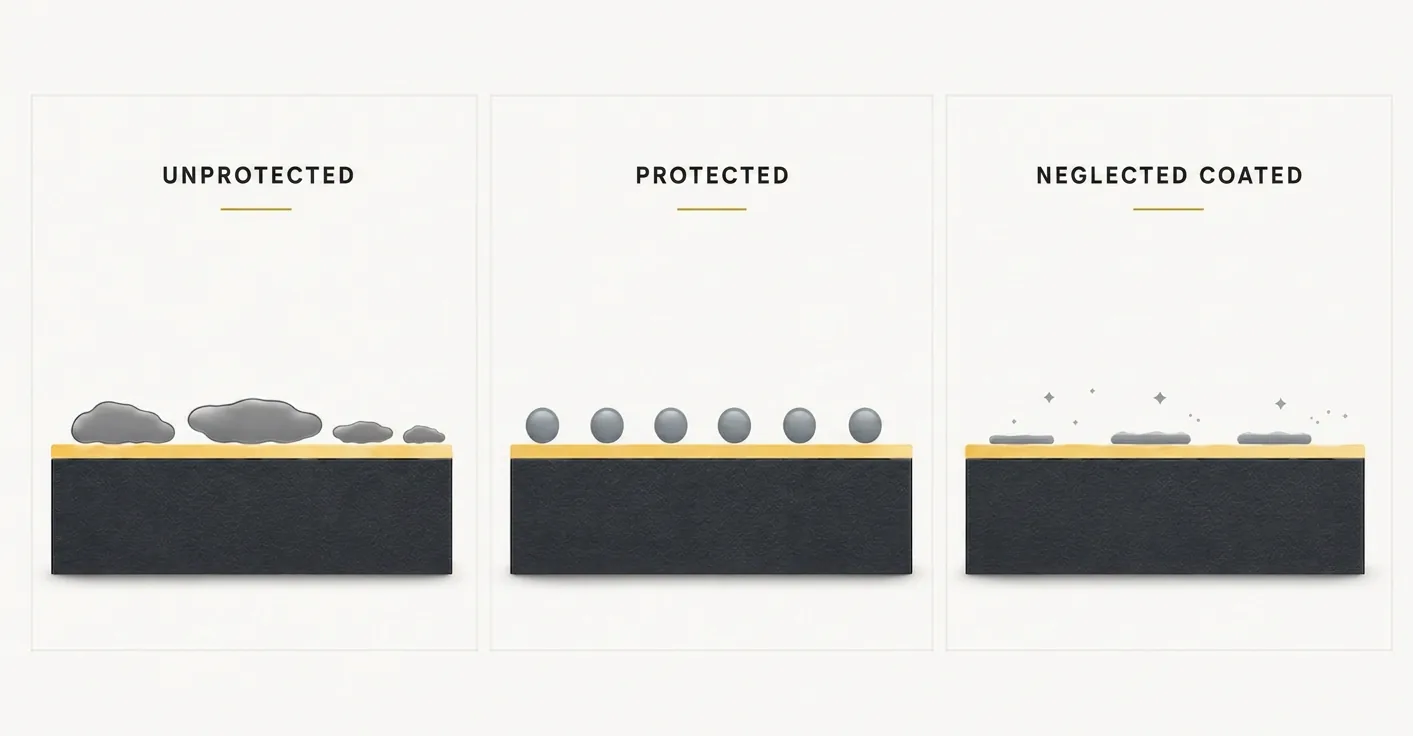
Where Ceramic Sits in the Surface System
Left: unprotected. Center: ceramic on qualified, prepared paint. Right: a coated finish that has not been maintained. Coating performance and surface condition are not the same thing.
Ceramic coating is most effective when the underlying finish is still sound. That makes newer vehicles and recently refinished vehicles strong candidates, because the work is done while the paint still has the durability to support long-term protection. Front ends in particular benefit from early protection, since hoods, front caps, mirrors, and leading edges absorb a disproportionate share of insects, road film, sunlight, and repeated cleaning.
What Ceramic Protection Supports and What It Does Not Replace
What It Supports
Easier routine washing and contamination removal
Improved water behavior on a clean, qualified surface
Surface slickness and gloss depth
Resistance to many common environmental exposures
A more manageable long-term maintenance program
What It Does Not Replace
Existing defects in the paint or clear coat
Rock chips and impact damage
Missing clear coat or exposed color
Body repair, corrosion repair, or failed graphics
Regular washing and periodic observation
02
Field Example · A group of recently delivered buses going straight into daily service
What you may notice. A transportation department takes delivery of several new buses that will run full schedules from an outdoor yard. The paint looks excellent on day one, and the question is when, not whether, to protect them.
Why it deserves attention. The finish is at its strongest the day the vehicle arrives. Once oxidation, contamination, and wash marring begin to accumulate, the available options narrow and the cost of recovering appearance increases.
What it may indicate. A new vehicle is generally a strong candidate for early ceramic protection, but a new vehicle is not automatically a prepared surface. Transport residues, shipping contamination, and panel-to-panel variability still need to be addressed before any coating is applied.
What we will look at. The condition of the delivered finish, whether any panels have been touched up at the dealer, the realistic wash environment the fleet uses, and the public-facing role of the vehicles.
Possible service direction. For qualified surfaces, the likely path is appropriate preparation followed by ceramic protection focused on the front-end and other high-exposure areas, supported by a wash program that is compatible with the coating.
Section 3.3 · SummitX Roof Preservation
SummitX Is a Roof-Preservation System, Not White Paint
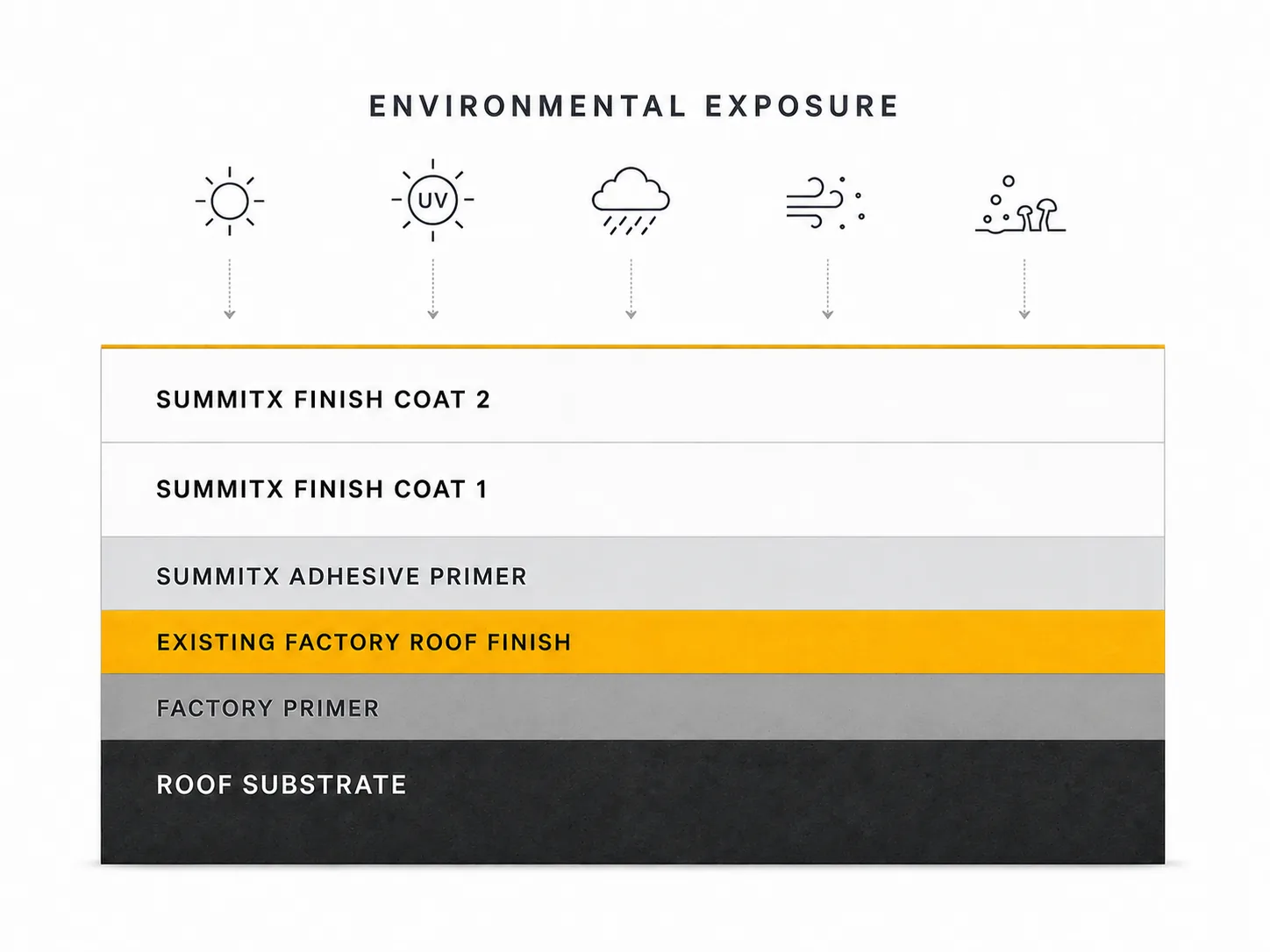
SummitX is a roof-preservation system, not simply white paint. The objective is not to make a roof look white. The objective is to preserve a qualified roof surface against ongoing exposure, with appropriate preparation, detailing around seams and penetrations, and a continuous reflective layer that performs as a complete system.
A fleet roof is one of the most exposed surfaces on the entire vehicle. It absorbs sunlight throughout the operating day, cycles through heat and cooling, sheds water and debris over seams and fasteners, and collects whatever the surrounding environment delivers. Over time, even a roof that looked uniform from the ground can develop chalking, discoloration, uneven repairs, or quiet failures around its seams. The visible appearance does not, by itself, reveal whether the roof is ready to be preserved.
Two buses with similar-looking roofs can require different preparation. One may have a stable substrate with normal weathering. The other may have had multiple previous repairs, a coating applied years ago, or trapped moisture under a patched seam. The purpose of an evaluation is to determine what must be corrected before the roof can be preserved as a complete system, rather than coated over and hoped to last.
The SummitX Roof System
Conceptual cross-section of the SummitX roof system: substrate, substrate-specific primer where required, intermediate build layers, and a continuous reflective finish coat performing together as one preserved surface.
How a SummitX Installation Is Sequenced
Roof-condition evaluation
Removal of contamination, chalk, oxidation, and loose incompatible material
Surface preparation appropriate to the existing substrate
Correction of seams, fasteners, prior repairs, and other items identified during evaluation
Substrate-specific primer where required
Application of the SummitX system layers to the approved specification
Verification of continuity and finished condition
Recommended future cleaning and observation
Reflectance, Emittance, and Realistic Expectations
Reflectance describes how much solar energy a roof reflects. Emittance describes how readily it releases absorbed heat. Both work together, and both depend on the surface staying reasonably clean once installed. Color alone does not make a roof a reflective system. Material type, preparation, primer, continuity, finished film build, and the condition of the substrate underneath all influence sustained performance.
Section 3.4 · Coating Build & Performance
Finished Film Build Decides How a System Performs
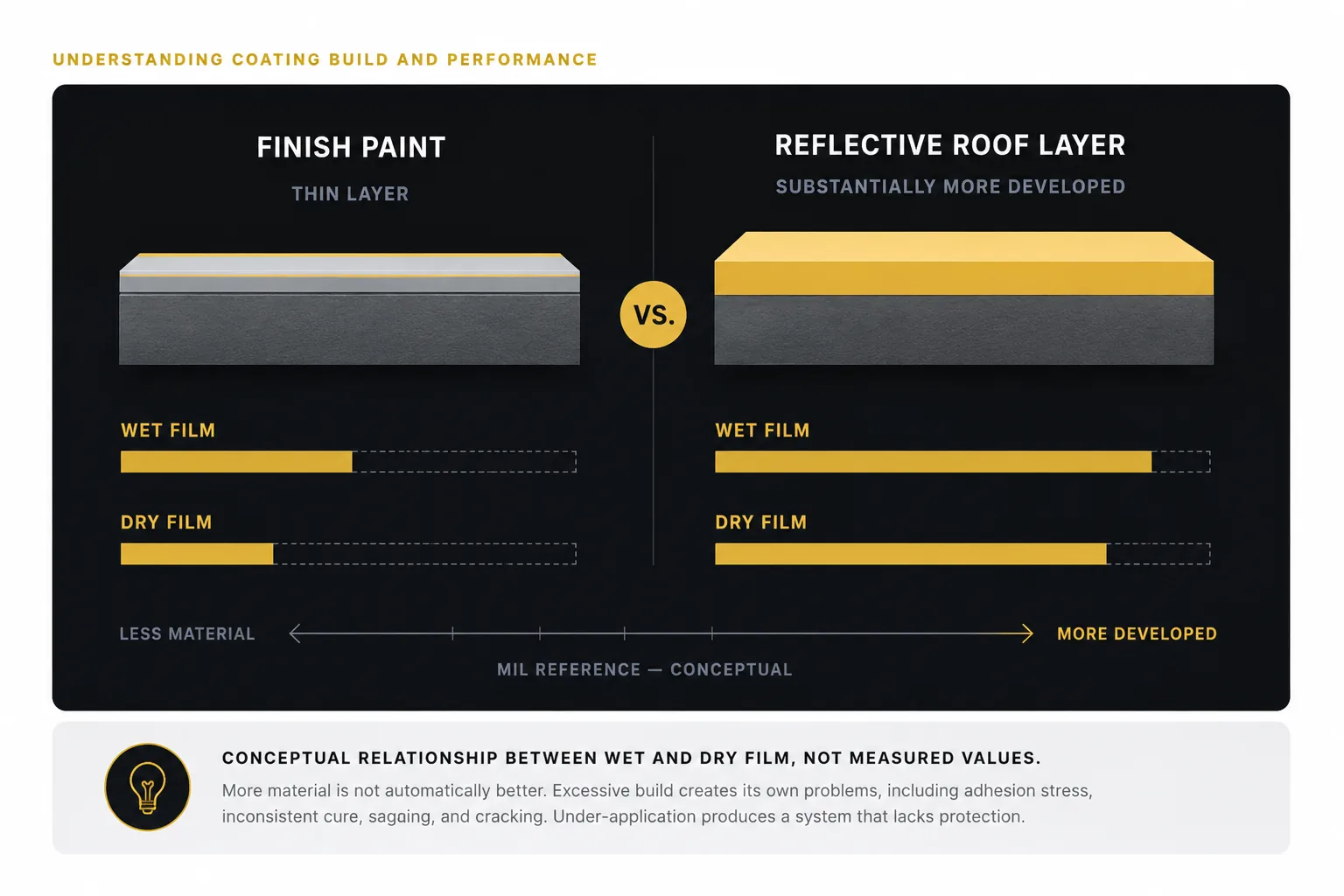
Film thickness describes how much coating material is actually present after the product has cured. Wet-film thickness is measured at the moment of application, before the solvents leave and the chemistry sets. Dry-film thickness is what remains after that process is complete, and it is the value that most closely represents the protective material the roof or panel will live with going forward.
A fleet manager does not need to memorize the numbers. What matters is that two roofs can both look white, can both be described as receiving two coats, and can still not contain the same amount of finished protective material. Appearance and coat count by themselves do not confirm that the intended system has been installed. The honest description is finished film build to the approved specification.
Wet Film vs. Dry Film
Wet-film thickness is the material present at the moment of application. Dry-film thickness is what remains after cure, and it is the value that determines how the system actually performs.
More material is not automatically better. Excessive build creates its own problems, including adhesion stress, inconsistent cure, sagging, and cracking. Under-application produces a system that does not perform as intended. The correct material build is the one specified by the system, applied to a properly prepared surface, and verified for continuity once it has cured. Preparation, compatibility, and application quality matter as much as the number on the gauge.
03
Field Example · A school bus roof is chalking, discolored, or showing previous repairs
What you may notice. A transportation department notices that several bus roofs look chalky from the maintenance walkway. The color is uneven across the fleet, a few seams show old patches, and one or two roofs have water staining visible inside the cabin.
Why it deserves attention. A roof that is allowed to weather without attention becomes harder and more expensive to address later. Chalking, exposed substrate, failing seams, and undetected moisture all change what an installation has to accomplish.
What it may indicate. The visible condition could represent normal weathering on a roof that is a strong candidate for preservation, or it could mask active intrusion that must be corrected first. Color alone does not separate the two.
What we will look at. The roof substrate, the remaining finish, previous coatings, seam condition, fastener condition, repairs, corrosion, loose material, evidence of active intrusion, and any signs of trapped moisture.
Possible service direction. Where the roof is suitable, the path is appropriate preparation followed by installation of the SummitX system. Where active leaks, failed seams, or substrate damage are present, those items are addressed before preservation is considered complete.
04
Field Example · The fleet wants to improve appearance without repainting every vehicle
What you may notice. Several vehicles are still serviceable mechanically but no longer look the way the operation wants them to. Repainting the entire fleet is not realistic, and full replacement is even further out.
Why it deserves attention. The cost difference between repainting a fleet and correcting or protecting a qualified one is significant. Choosing the wrong service for a borderline surface, however, usually costs more than choosing the right one the first time.
What it may indicate. Some vehicles will qualify for washing alone, some for paint correction with ceramic protection, and some for professional refinishing or repainting by a qualified refinishing facility. Roofs are evaluated on their own terms.
What we will look at. The condition of each major panel type, the history of the vehicles, the consistency of appearance the fleet needs to achieve, and the realistic downtime the operation can absorb.
Possible service direction. A combined program of washing, paint correction, ceramic protection, SummitX roof preservation, and — where the finish has failed — professional refinishing or repainting by a qualified facility, matched to the actual condition of each vehicle rather than a single service applied across the fleet.
From Guidance to Action
Let the Surface Make the Decision
We’ll inspect a representative group and identify what qualifies for correction, protection, preservation, washing—or refinishing first.
A protected fleet is a maintained fleet. This chapter covers the washing, observation, and program planning that hold every other service in place over time, along with the questions fleet managers ask most often when building a long-term preservation plan.
Section 4.1 · Maintenance Washing
Fleet Washing Is Part of the Preservation System
Fleet washing is the single most effective maintenance practice for protecting appearance, slowing contamination buildup, and extending the useful condition of every exterior surface on the vehicle. It is also the part of the program that has the biggest influence on whether everything else Alpine performs continues to look and perform the way it should.
Most fleet contamination begins as loose road soil. Left in place, it absorbs moisture, traps minerals, and bonds more tightly to the finish with every cycle of heat, sun, and humidity. A fleet that is washed regularly tends to wash easily. A fleet that has gone too long between cleanings often requires a more involved reset before normal washing can keep up again. That is the difference between ongoing maintenance and corrective cleaning, and the two should not be confused with each other.
A fleet manager may notice that buses still look gray after a quick rinse, that lower panels develop an oily film between washes, that insect residue continues to sit on front caps, or that water spots keep forming around glass and trim. Those observations usually have less to do with the soap being used and more to do with the type of contamination, the water quality, the drying conditions, and the interval between washes.
Water Quality and Drying
Minerals remain on a panel after water evaporates. When that happens on a hot surface, the minerals concentrate and contribute to the spotting and hazing that fleets commonly attribute to “hard water.” On dark paint, glass, trim, roofs, and protected finishes, water quality and drying technique often matter more than which soap is selected.
How Often a Fleet Should Be Washed
There is no universal interval. Wash frequency depends on route exposure, storage, season, public visibility, soil accumulation, existing protection, local water quality, current maintenance method, and the availability of the vehicles themselves. The right cadence for one fleet may be wrong for another, and the right cadence for a single fleet may shift seasonally.
01
Field Example · Water spots or mineral deposits continue returning
What you may notice. Spotting reappears within days of a wash. Glass, mirrors, and dark panels show the deposits most clearly, and they begin to feel slightly rough to the touch over time.
Why it deserves attention. Mineral deposits become harder to remove the longer they sit. What started as a cleaning problem can quietly become an etching problem if the cycle is not addressed.
What it may indicate. Local water quality, air drying on hot panels, repeated runoff from roofs and upper surfaces, and the absence of compatible surface protection can all contribute.
What we will look at. The current wash and dry process, water condition, the presence of any existing coating, and whether the deposits are still surface-level or have begun to etch the finish.
Possible service direction. Adjustments to the wash program, mineral-deposit treatment, decontamination where appropriate, and, on qualified surfaces, ceramic protection to reduce how aggressively new deposits bond.
02
Field Example · The fleet becomes visibly dirty again soon after washing
What you may notice. Buses look clean leaving the wash bay and look noticeably dirty within a few operating days. Lower panels gray quickly and rear surfaces collect a darker film than the rest of the vehicle.
Why it deserves attention. A fleet that never looks clean for long becomes harder to maintain in every other sense, and the cleaning that does happen becomes more aggressive than it needs to be.
What it may indicate. Ordinary loose soil, accumulated road film, mineral residue, organic contamination, or contamination that has reached a point where it requires a more specialized process than routine washing.
What we will look at. The current wash method, the realistic interval between washes, the route and storage conditions, and the type of contamination actually present on the surface.
Possible service direction. Adjustments to the wash program, targeted decontamination where appropriate, and consideration of surface protection on qualified vehicles to slow how quickly contamination re-bonds.
Section 4.2 · Fleet Program Planning
Protection Works Best as a Program
Protection works best as a program rather than a one-time event. A coordinated approach to washing, paint correction, ceramic protection, and SummitX roof preservation — with professional refinishing or repainting handled by a qualified refinishing facility where the finish has failed — produces better outcomes and more predictable budgets than reactive work performed only when a vehicle has already started to look tired.
A practical program usually begins with a small representative group of vehicles. That allows the fleet and Alpine to see how the surfaces respond, what immediate failures exist, and which non-candidates should be set aside before any wider commitment is made. Once the appropriate paths are established, work can be sequenced around vehicle availability, route assignments, and the realistic downtime the operation can absorb.
Different phases of a fleet have different priorities. Newer vehicles often benefit most from early ceramic protection, front-end attention, and a baseline wash program. Midlife vehicles may be the strongest candidates for condition-appropriate paint correction followed by ceramic protection, or — where the finish has failed — for evaluation by a qualified refinishing facility. Roof preservation is its own decision, governed by substrate condition rather than vehicle age. Reassignment and resale preparation tends to focus on targeted correction and appearance work rather than any broader intervention.
What to Know Before Planning the Work
Vehicle age and remaining service life
Replacement and reassignment schedule
Surface condition and prior repair history
Public visibility and route exposure
Storage conditions and current wash program
Realistic downtime and access windows
Operating budget and long-term objective
Section 4.3 · Common Questions
Brief Answers to the Questions Fleets Ask Most Often
The questions below are the ones fleet customers ask most often when they begin considering Alpine’s services. The answers are intentionally brief, since the rest of the guide already covers the underlying detail. They are meant to provide quick clarity rather than a complete explanation of each topic.
In many cases, yes. When the underlying finish is still stable, condition-based paint correction and professional ceramic protection can recover and preserve appearance without refinishing. When the paint system has already failed, professional refinishing or repainting by a qualified refinishing facility is still the appropriate path. The evaluation determines which situation you are actually in.
Usually not. Even similar-looking vehicles can have different histories, repairs, and remaining finish condition. The most consistent fleet outcomes come from matching the service to each vehicle rather than applying one program across every unit.
No. A ceramic coating makes washing easier, helps gloss hold longer, and slows how aggressively contamination bonds to the surface. It does not remove the need to wash, and it does not address damage that is already present in the finish underneath it.
Coating an already-failing finish typically locks in the appearance of the failure. Faded or weathered surfaces usually need to be evaluated for correction first, and where the paint system has failed, professional refinishing by a qualified facility is the appropriate step. Ceramic protection is then applied only to a recovered or qualified surface, not to the damage.
We look at the remaining finish, the substrate underneath, any visible repair history, and how the surface responds to a small prepared area. Photographs can begin the conversation. The decision about correction and ceramic protection versus professional refinishing is made on the vehicle.
Sometimes. It depends on the type and condition of the existing coating, how well it remains bonded, and whether the roof beneath it is sound. We evaluate compatibility and adhesion before treating an existing coating as part of the prepared surface.
No. SummitX is a preservation system, not a roof repair. Active leaks, failed seams, loose materials, corrosion, and trapped moisture are addressed before preservation is considered complete.
Two roofs can both look white and can both be described as receiving two coats and still not contain the same amount of finished protective material. Film build is one of the factors that determines whether the system installed on the roof matches the system specified for the roof.
Downtime depends on the service, the condition of the vehicle, the number of units, weather, and access. Estimates are provided after evaluation so they reflect the work actually required rather than a generic schedule.
A brief description of the fleet, the number and type of vehicles involved, where they are stored, what you have observed, any known repair or coating history, and the outcome you are trying to achieve. Unknown items can simply be identified as unknown.
Yes. Starting with a representative group is often the most practical way to establish what each part of the fleet will need before any broader commitment is made.
SummitX is Alpine Fleet Coatings’ ceramic roof preservation system, designed to protect and extend the service life of qualified fleet roofs.
Chapter 01 of 04
Before You Schedule
What an Evaluation Helps Determine
A surface evaluation helps identify which areas are stable, which areas are deteriorating, and which service path makes the most sense. Alpine looks at material type, gloss retention, oxidation, coating thickness where appropriate, previous repairs, graphics, roof condition, and signs of coating failure.
The recommendation may include condition-based paint correction, professional ceramic protection, reflective roof preservation, maintenance washing, professional refinishing or repainting by a qualified refinishing facility, or a combination of these paths. Just as important, the evaluation helps identify when a service should not be performed.
Putting Principles Into Practice
Dedicated Alpine Service Paths
This Technical Guide serves as our foundational educational authority framework. When you are ready to transition these principles into active yard operations, explore our specialized mobile surface solutions:
While this Technical Guide acts as Alpine's primary educational authority reference, our Field Notes archive provides supporting article-style deep dives into fleet budgeting, technician shortages, replacement intervals, and specific case studies.
A technically appropriate recommendation begins with understanding the vehicle, the existing surface, its history, its exposure, and the result the fleet is trying to achieve.