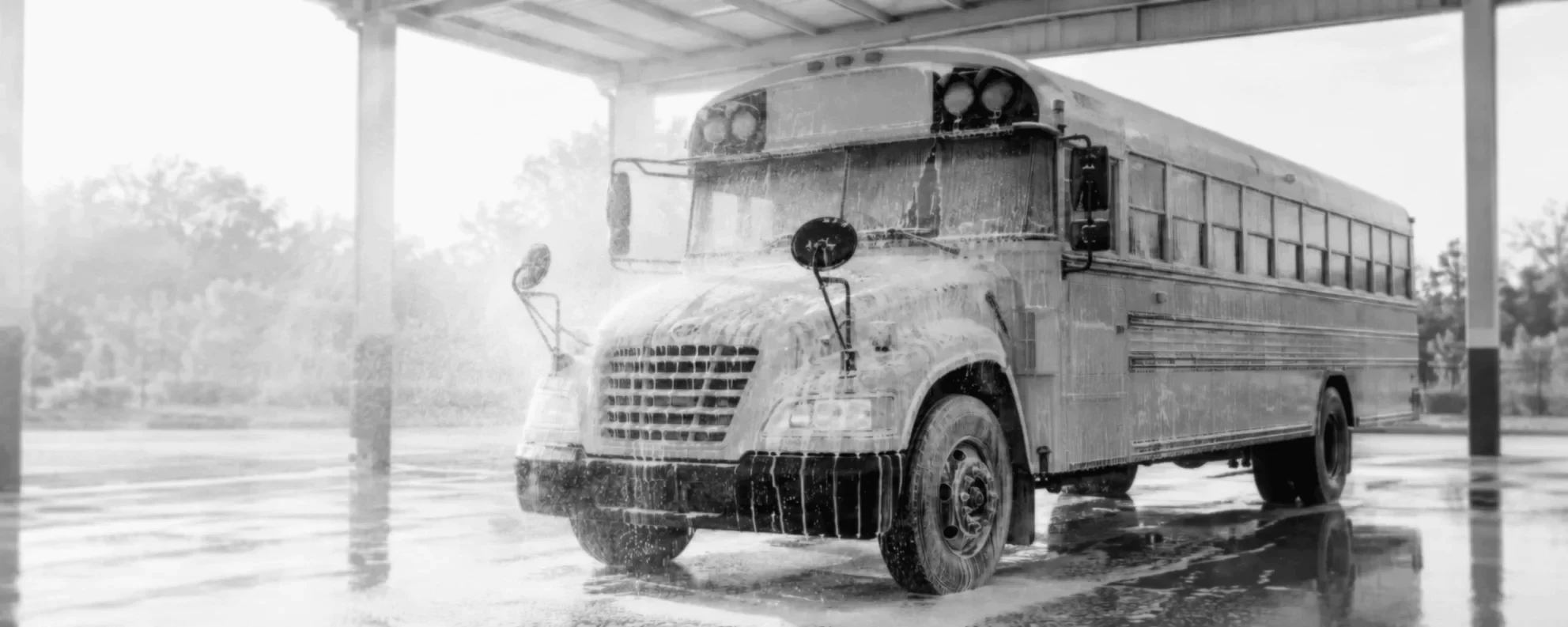
Why It Matters
Without a standard, visible condition becomes subjective. One driver reports damage immediately, another assumes it is already known, and one facility washes frequently while another waits until buildup becomes severe.
The result is not merely inconsistent appearance. It is inconsistent observation, documentation, and accountability.
An operating standard gives visible condition a repeatable place in the fleet’s existing maintenance system without assigning it the same urgency as brakes, tires, inspections, or mechanical defects.
Appearance Is Not the Same as Perfection
The phrase “appearance standard” can sound unrealistic for a working fleet.
School buses operate through rain, heat, insects, road film, and stop-and-go routes. Service trucks work around tools, equipment, mud, chemicals, and active job sites. Highway vehicles accumulate miles and exposure at a pace that makes lasting perfection impossible.
A useful appearance standard acknowledges those realities.
Its purpose is not to keep every vehicle in showroom condition. It is to define the point at which ordinary wear becomes unmanaged condition.
That boundary may be crossed when heavy contamination remains indefinitely, new damage goes unreported, required markings become difficult to read, windows or lighting are obstructed, or paint, fiberglass, roofs, and other exterior materials show active deterioration.
The standard should reflect what each vehicle does. A construction vehicle and a customer-facing service van should not be judged by identical daily expectations.
Both, however, can have an appropriate definition of ready.
What Ready Looks Like Should Not Be Left to Interpretation
Fleet operations already depend on standards.
Organizations establish expectations for tires, brakes, lighting, fluid levels, safety equipment, preventive maintenance intervals, defect reporting, inspection documentation, and vehicle availability.
Those standards reduce uncertainty by defining what must be observed, what should be reported, and what conditions require further action.
Appearance is frequently handled less consistently. One driver may view a vehicle as acceptably clean while another considers it neglected. One facility may wash vehicles every week while another waits until buildup becomes severe. Minor damage may be reported immediately, discovered months later, or never formally documented.
Without a defined standard, visible condition becomes subjective.
Fleetio’s vehicle-maintenance guidance emphasizes standardization, consistent inspections, reliable records, clear responsibility, and a closed path from issue identification to documented resolution. [1]
An appearance standard can follow the same principle. It should define the expected condition, who observes and reports concerns, how often condition is reviewed, which concerns require prompt action, and how completed work is recorded.
Cleanliness Improves Visibility, Not Mechanical Condition
Cleaning should never be presented as a substitute for a formal safety or mechanical inspection.
It can improve the conditions under which observation occurs.
Heavy dirt and buildup may conceal new body damage, small leaks, deteriorating seams, paint failure, corrosion, cracked lighting, loose trim, failed markings, or other surface damage.
When a vehicle is periodically cleaned and viewed closely, there are more opportunities to recognize those changes before they blend into the general condition of the fleet.
That is particularly relevant for larger operations where no single manager can inspect every vehicle personally.
A driver walk-around, wash-quality review, or periodic condition check can help determine whether new damage is present, whether windows, mirrors, cameras, lighting, and required markings remain clear, and whether exterior materials require cleaning, documentation, corrective work, or further inspection.
Appearance care becomes useful when it supports observation and follow-through rather than attempting to replace mechanical judgment.
Exterior Condition Is Also an Asset-Management Issue
The appearance of a vehicle becomes especially noticeable when it is reassigned, evaluated for replacement, or offered for sale.
By that point, however, years of accumulated deterioration may be difficult or expensive to correct.
Automotive Fleet has reported that traditional used-vehicle evaluation still considers visible factors such as mileage, tire condition, interior wear, exterior appearance, and how the vehicle operates. Connected-vehicle data may provide better evidence of mechanical health, but it does not remove the immediate effect of visible condition. [2]
Not every scratch or cosmetic repair will produce a measurable financial return. Fleet managers must judge whether correction is worth the cost based on age, use, remaining service life, operational role, and expected disposal value.
A long-term condition plan may include routine washing appropriate to the operating environment, timely contamination removal, periodic exterior inspection, documentation of new damage, early corrosion or material-failure evaluation, and planned preservation before reassignment or disposal.
The objective is not merely to improve how a vehicle looks today. It is to prevent manageable surface conditions from becoming future restoration projects.
The Federal Transit Administration’s asset-management guidance emphasizes condition assessment, lifecycle planning, and the use of asset information to support dependable operations and capital decisions. [3]
Appearance should not determine replacement on its own. It should be included as one part of the asset’s documented condition and remaining value.
Condition Communicates Expectations to Employees
Employees notice the condition of the equipment they are assigned.
A clean vehicle does not automatically produce a better driver, technician, or workplace culture. It would be an overstatement to claim otherwise.
Condition can still communicate what the organization expects.
When equipment is consistently maintained, employees receive a signal that damage should be reported and the asset should be treated responsibly. When vehicles remain dirty for long periods, visible damage goes unaddressed, or deterioration is allowed to spread, the opposite expectation may gradually take hold.
Small problems become easier to ignore when neglect already appears normal.
An effective standard should not become punitive. Drivers often share equipment, operate difficult routes, work within tight schedules, and have limited access to proper washing resources. Management must provide a realistic process and respond consistently when concerns are reported.
School Bus Fleet has connected a culture of cleanliness with staff accountability, employee morale, student behavior, public perception, and family confidence. [4]
The lesson applies beyond school transportation. Vehicle condition influences how employees experience the equipment and how clearly the organization’s expectations are understood.
The Public Sees the Vehicle Before It Sees the Maintenance Program
Most customers, parents, residents, and members of the public will never see a fleet’s preventive maintenance records. They will not see completed work orders, driver inspections, replacement schedules, or the budget constraints behind daily operations.
They see the vehicle.
A school bus moving through a neighborhood, a municipal truck beside a road, an ambulance arriving at a facility, or a service vehicle entering a customer’s driveway becomes a visible representation of the organization behind it.
Appearance does not prove safety or reliability. A clean vehicle may still have mechanical problems, while an older vehicle may be maintained exceptionally well. Public perception, however, rarely has access to that distinction.
A consistent, presentable fleet can communicate preparedness, attention, and respect for the equipment. A visibly neglected fleet may create questions about care and reliability even when the underlying maintenance program is sound.
That is why vehicle appearance should be managed intentionally rather than addressed only when presentation suddenly becomes important.
“A working fleet should show evidence of work. It should also show evidence that someone is paying attention.”
The Standard Should Fit the Fleet
There is no universal washing schedule or appearance policy that works for every operation.
The standard should reflect the vehicle’s role and duty cycle, its operating environment and exposure, customer or public visibility, present material condition, available labor and equipment, access to qualified outside support, and manufacturer requirements for specific surfaces.
A fleet with high-visibility customer vehicles may need frequent washing and condition review. A seasonal operation may benefit more from scheduled deep cleaning and periodic assessment. A school transportation department may use summer downtime for preservation projects that are difficult to complete during the school year.
The same standard does not need to apply identically to every asset. Daily expectations for a construction vehicle may differ from those for a customer-facing service van, school bus, ambulance, or executive vehicle.
The right standard is not the most ambitious one.
It is the one the organization can fund, follow, inspect, and improve consistently.
What an Operating Standard Actually Requires
A practical operating standard can be built around five elements.
1. Define acceptable condition. Describe what reasonably clean, presentable, and ready mean for each major vehicle category. Avoid vague instructions such as “keep vehicles clean.” Define the conditions that should trigger cleaning, reporting, documentation, or further evaluation.
2. Use a repeatable observation process. Add a limited number of visible-condition items to existing driver checks, wash reviews, annual inspections, or scheduled fleet-condition assessments. Do not create unnecessary paperwork when an existing process can carry the information.
3. Assign reporting responsibility. Drivers and employees should know how to report new damage, failed markings, surface deterioration, persistent contamination, or other visible concerns. Responsibility must also be assigned for reviewing the report and deciding what happens next.
4. Prioritize the response. Not every condition requires immediate correction. Separate issues into reasonable groups: a safety or compliance concern, active deterioration requiring evaluation, a routine cleaning or maintenance need, planned preservation work, or a cosmetic issue that may be monitored or deferred.
5. Maintain useful documentation. Dated photographs and condition records can help fleets compare deterioration over time, track recurring damage, evaluate outsourced work, support budget requests, prepare vehicles for reassignment or disposal, and identify routes or locations producing unusual wear.
The purpose is not to produce another form. It is to create a closed path from observation to decision.
Appearance Should Support Maintenance, Not Compete With It
A fleet appearance program should never delay a safety repair, required inspection, critical mechanical service, or necessary vehicle replacement.
It should not be used to disguise the age of an asset or imply that a polished vehicle is automatically ready for service.
A vehicle can look excellent and still be mechanically unsound. Another can show years of honest work while remaining reliable and properly maintained.
The better approach is to stop treating mechanical care and visible condition as opposing ideas.
Safety, reliability, cleanliness, documentation, and preservation address different parts of asset stewardship. They can carry different priorities while still belonging to the same operating plan.
For covered commercial fleets, federal regulations require systematic inspection, repair, maintenance, and records for vehicle systems affecting safe operation. An appearance standard should remain distinct from those legal duties while borrowing the same discipline of assigned responsibility and documented follow-through. [5]
The relevant question is not whether appearance deserves the same urgency as brakes, tires, inspections, or mechanical defects.
It is whether preventable deterioration should remain unmanaged simply because it is visible rather than mechanical.
Sources & Further Reading
- 1.Fleetio, “Vehicle Maintenance Program: Strategy, Costs and ROI,” updated December 23, 2025.
- 2.Automotive Fleet, “How Connected Vehicle Data Is Lifting Fleet Resale Values,” May 18, 2026.
- 3.Federal Transit Administration, Transit Asset Management and State of Good Repair guidance.
- 4.School Bus Fleet, “Creating a Culture of Clean: Why Sanitation Is a Cornerstone of Student Safety,” December 4, 2025.
- 5.Electronic Code of Federal Regulations, 49 CFR Part 396, Inspection, Repair, and Maintenance.
Related Field Notes
- Fleet Planning12-minute read
Repair, Refurbish, or Replace?
A practical framework for determining whether the next fleet dollar should correct an isolated problem, restore broader useful life, or move the organization toward replacement.
- Maintenance & Operations9-minute read
In-House or Outsourced? How Fleet Managers Should Decide Who Handles the Work
A practical guide to deciding which fleet work belongs with internal staff, when specialized vendors make sense, and how managers should evaluate labor, downtime, equipment, risk, and total cost.
- School Transportation10-minute read
How Long Should a School Bus Remain in Service?
Age and mileage are important, but they rarely tell the whole story. This Field Note examines the condition, cost, reliability, route demands, and replacement planning that should determine a school bus's true useful life.
From Alpine Fleet Coatings
Managing a working fleet in Georgia?
Alpine Fleet Coatings provides mobile exterior protection, preservation, and maintenance-washing services across Georgia. When your vehicles are ready for professional exterior care, we bring the equipment and process directly to your yard.