Why It Matters
Uniform maintenance schedules are administratively attractive. One mileage threshold is easy to understand, communicate, and monitor. When vehicles share the same chassis, engine, body, or vocation, a common schedule may also be appropriate.
The difficulty is that fleets are rarely as uniform in operation as they appear on an asset list. When unlike assignments are treated as identical, a fleet can select the wrong published maintenance schedule, compare units that do not perform comparable work, or overlook substantial stationary operation and environmental exposure.
That does not mean every vehicle needs different treatment in every category. It means mileage alone cannot prove that their maintenance demand, exposure, or condition should be identical.
The management question is not simply: How far did the vehicle travel?
It is: What work did the vehicle perform while accumulating those miles?
Mileage Measures Distance, Not Severity
The odometer is valuable because it provides a consistent measure.
Mileage can show:
• Distance traveled
• Utilization patterns
• Cost per mile
• Progress toward mileage-based service requirements
• Mileage accumulated by vehicle, route, location, or department
• One part of the vehicle’s useful-life history
Mileage does not independently show:
• Total engine hours
• Idle or power takeoff time
• Starts, stops, turns, or braking events
• Average speed or route density
• Passenger, cargo, towing, or equipment load
• Terrain and road condition
• Heat, cold, dust, moisture, chemicals, insects, road film, or seasonal exposure
• Outdoor storage or extended inactivity
• Repeated washing, bonded contamination, or changing exterior condition
Vehicle manufacturers already recognize these differences. Published maintenance guidance may identify special operating conditions such as extensive idling, low-speed commercial use, towing, dusty roads, short trips, or extreme temperatures. Engine manufacturers may also use hours, fuel consumption, application, idle time, power takeoff use, or duty-cycle classifications when establishing maintenance requirements. [1][2]
Mileage supplies the starting measure. Duty cycle supplies the operating context.
Same Odometer, Different Work
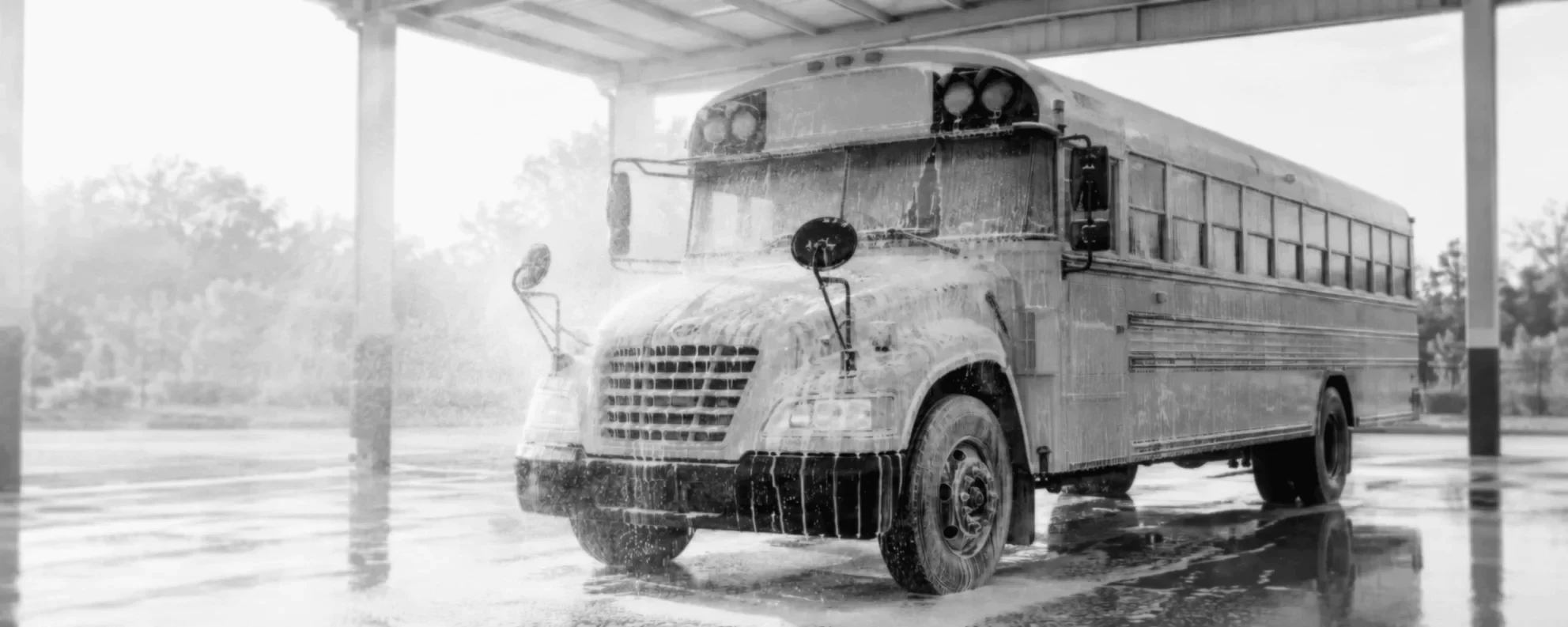
Consider two school buses that cover similar annual mileage. One may spend longer periods at steady speed on rural roads. The other may accumulate the same distance through dense routes with more stops, turns, braking events, door cycles, and idle time. Their odometers can agree while their operating patterns differ materially.
Low-mileage vehicles create a separate blind spot. A municipal utility truck may travel only a few miles before operating mounted equipment for hours. A reserve vehicle may move very little while aging outdoors and receiving less frequent observation.
None of these examples proves that one vehicle is automatically harder to maintain. A good duty-cycle review identifies what each assignment demands and where the fleet should look for its effects.
What Actually Defines Duty Cycle
Duty cycle is broader than a label such as highway, city, school bus, or service truck. Six factors help describe it more accurately.
01 | Movement Pattern
Consider steady travel, short trips, average speed, stop-and-go operation, starts, turns, braking, reversing, and tight maneuvering.
Two routes with equal mileage can create very different patterns of movement.
02 | Operating Time
Review total engine hours, idle time, power takeoff time, accessory demand, and time spent operating while the odometer advances very little.
A stationary vehicle can still be working.
03 | Work Performed
Account for passenger load, payload, towing, mounted equipment, auxiliary systems, climate-control demand, and the vehicle’s vocational function.
Vehicle class describes what the asset is. Duty cycle describes what the organization asks it to do.
04 | Route Environment
Consider grades, congestion, rough surfaces, unpaved roads, construction areas, low-speed operation, and tight turns.
Route conditions can change workload and the maintenance guidance that applies without changing the odometer’s basic message.
05 | Climate and Exposure
Include operating heat, cold, moisture, dust, mud, insects, deicing chemicals, and other environmental conditions encountered during use.
For whole-asset planning, record ultraviolet exposure, industrial fallout, tree cover, and outdoor storage in a companion exposure field. Those conditions can continue while the vehicle is parked.
06 | Utilization and Assignment
Review shift length, daily frequency, seasonal inactivity, assignment changes, shared use, reserve status, and whether the vehicle repeatedly moves between different routes or operators.
“The odometer records how far the vehicle traveled. Duty cycle explains what the vehicle endured along the way.”
A Practical Duty-Cycle Framework
A fleet does not need a unique maintenance plan for every asset. It needs enough structure to recognize when similar vehicles perform meaningfully different work. The following three profiles combine a mechanical duty-cycle review with a companion exposure review for whole-asset planning.
These are internal planning labels, not manufacturer maintenance classifications. Manufacturer and component-specific definitions of normal, severe, vocational, or special operating conditions remain controlling.
01 | Routine Duty
Typical indicators
• Predictable assignment
• Primarily steady operation
• Limited idle or power takeoff time
• Moderate loads
• Mostly paved routes
Management response
Continue all applicable manufacturer, regulatory, inspection, and local maintenance requirements. Maintain routine condition documentation and enough operating data to recognize when the assignment changes.
02 | Elevated Duty
Typical indicators
• Frequent stops or short trips
• Sustained idle or power takeoff use
• Heavier or variable loads
• Congestion, grades, rough surfaces, heat, dust, or outdoor exposure
• Repeated contamination or demanding wash conditions
• One or more persistent operating stressors
Management response
Confirm whether manufacturer-defined severe-service, vocational, or special-operating guidance applies. Add focused observation of the systems and surfaces most affected by the assignment. Compare wear, defects, downtime, and condition with genuinely similar vehicles.
03 | Intensive Duty
Typical indicators
• Several elevated-duty conditions occurring together
• Dense stop-start operation
• High idle or power takeoff time
• Heavy vocational loads
• Rough, contaminated, or unusually demanding environments
Management response
Create a documented unit-level plan using applicable manufacturer guidance, qualified maintenance judgment, operating data, and condition history. Review trends more closely and account for availability, reserve capacity, exterior exposure, and the vehicle’s expected remaining role.
A vehicle can move between profiles when its route, assignment, payload, equipment, environment, storage, or season changes.
Vehicle type alone should not determine the profile.
Manufacturer Guidance Still Sets the Boundary
Duty-cycle planning should help a fleet determine which requirements apply. It should never become permission to invent maintenance intervals.
The correct chassis, engine, transmission, body, mounted-equipment, and component documentation should remain the starting point. Requirements may use mileage, hours, calendar time, fuel use, operating conditions, or onboard monitoring, and definitions can vary among components on the same vehicle.
Cummins, for example, publishes X12 maintenance guidance that distinguishes severe, short-haul, normal, light, and vocational operation, and changes the applicable interval when idle and power takeoff time exceed a defined threshold. [2] Ford publishes special-operating-condition guidance addressing idling, low-speed commercial driving, heavy traffic, loading, dust, off-road use, short trips, and temperature extremes for applicable vehicles. [1] These are manufacturer-specific examples, not universal formulas.
They do not authorize extending a required interval because a vehicle appears lightly used. They do not replace regulatory inspections, warranty terms, recalls, local procedures, or professional diagnosis. For covered commercial motor vehicles, federal rules require systematic inspection, repair, and maintenance with records identifying due dates and completed work, but they do not impose one universal interval for every fleet and vehicle. [3]
Engine Hours Need Context, Too
Engine hours reveal activity that mileage cannot, particularly for vehicles that spend meaningful time operating while stationary or moving slowly. They are not a universal substitute for mileage. An hour at idle differs from an hour under load, so verify how the fleet’s system defines idle time.
The most useful view combines:
• Odometer mileage
• Total engine hours
• Idle and power takeoff hours where available
• Route or assignment
• Typical load and equipment use
• Maintenance and defect history
• Fuel or energy use
• Environmental and storage conditions
Avoid generic engine-hours-to-miles conversions unless the applicable manufacturer provides one for that equipment and application. The objective is context, not another oversimplified number.
What Duty Cycle Should Change
A duty-cycle review should lead to specific management decisions.
Schedule Selection
Determine which manufacturer schedule and special-operating guidance apply. Where a requirement is stated as miles, hours, or time, follow the applicable “whichever occurs first” instruction.
Inspection Emphasis
Give additional attention to the systems affected by the actual assignment. Dense stop-and-go work, unpaved routes, mounted equipment, high idle time, heavy loading, and environmental exposure do not create identical inspection priorities.
Trend Review
Compare repeat repairs, road calls, abnormal wear, fuel or energy use, warning events, and downtime among vehicles performing comparable work.
Comparing unlike vehicles can make a normal difference appear like a defect or allow a genuine exception to disappear inside the fleet average.
Availability Planning
Vehicles assigned to high-consequence work may need stronger reserve coverage, parts readiness, or scheduling protection. Mission criticality affects the consequence of downtime even when it does not change the vehicle’s physical duty cycle.
Condition and Preservation
Align washing, contamination removal, exterior review, and preservation planning with actual exposure and material condition.
The right result is not more maintenance for every vehicle. It is better-targeted attention based on documented need.
Extend the Review to Exterior Exposure
Mechanical duty cycle does not describe every condition affecting the asset. For whole-asset planning, the fleet should pair it with an exterior-exposure record.
A low-mileage vehicle stored outdoors can accumulate more environmental exposure than a higher-mileage unit kept under cover. A highway vehicle may collect insect residue and road film. A construction or utility vehicle may encounter dust, mud, or work-site contamination. A school bus roof may receive prolonged sun and heat exposure during limited use.
Manufacturer care guidance may identify contaminants that require timely removal. Ford’s guidance, for example, identifies substances such as insect residue, bird droppings, tree sap, road salt, tar, and industrial fallout that should be removed to avoid paint-surface damage. Ford also advises frequent underbody washing where road salt is used and notes that suspension components may require regular cleaning in dusty or muddy service. [4]
That does not create one universal washing frequency. Exterior care should consider:
• Operating environment
• Type and persistence of contamination
• Outdoor or covered storage
• Material and coating condition
• Graphics, markings, sensors, lighting, and trim
• Manufacturer care requirements
• Available labor, water, equipment, and responsible outside support
Cleaning can improve visibility of exterior condition, but it does not replace a mechanical or safety inspection. The objective is not constant washing. It is preventing exposure from outrunning the fleet’s ability to observe and manage condition.
Let Exceptions Challenge the Category
A duty-cycle profile is a starting hypothesis, not a permanent label.
The fleet should reconsider a classification when it sees:
• Repeat repairs
• Unexpected tire or brake wear
• Increasing road calls
• Frequent warning or regeneration events
• Rising downtime
• Repeated driver-reported defects
• Fuel or energy use that differs materially from comparable units
• Rapid contamination or exterior deterioration
• A maintenance pattern inconsistent with the assigned profile
Not every recurring problem is caused by hard use. A pattern may indicate a defective component, unsuitable specification, incomplete repair, training need, route issue, data problem, or mismatched assignment. Duty cycle should improve the questions, not become an automatic explanation after failure.
Build Duty Cycle Into Existing Records
The fleet does not necessarily need another form or software platform. It needs a small number of dependable fields attached to the existing vehicle record.
Where relevant and available, document:
• Primary assignment or vocation
• Route or service type
• Odometer
• Total engine hours
• Idle and power takeoff hours
• Typical load or mounted equipment
• Operating environment
• Storage and exposure
• Recurring failure or wear pattern
• Internal duty-cycle profile
• Date and reason for the current classification
• Trigger for reassessment
The National Laboratory of the Rockies’ commercial-vehicle tools characterize real-world duty cycles using measures such as operating time, speed, stops, key-on/off data, engine power, and road grade. [5] Transit research and federal asset-management guidance similarly support using work-order history, failures, age, condition, and local operating experience when evaluating assets and maintenance practices. [6][7]
Review the classification when a route, season, assignment, payload, equipment configuration, storage location, or operating pattern changes. A simple classification that is reviewed and used will produce more value than a detailed model that becomes another abandoned field.
Sources & Further Reading
- 1.Ford Motor Company, 2026 F-650/F-750 Owner’s Manual: Special Operating Conditions Scheduled Maintenance.
- 2.Cummins Inc., X12 2024 Maintenance Intervals.
- 3.Federal Motor Carrier Safety Administration, Systematic Inspection, Repair, and Maintenance and 49 CFR § 396.3.
- 4.Ford Motor Company, Vehicle Care: Cleaning the Exterior and Body Paintwork Preservation and Cleaning the Exterior and Underbody.
- 5.National Laboratory of the Rockies, Fleet DNA and Transportation Data and Tools.
- 6.Transportation Research Board, TCRP Synthesis 81: Preventive Maintenance Intervals for Transit Buses (2010).
- 7.Federal Transit Administration, Transit Asset Management and Long Beach Transit Condition Assessment Example.
Related Field Notes
- School Transportation10-minute read
How Long Should a School Bus Remain in Service?
Age and mileage are important, but they rarely tell the whole story. This Field Note examines the condition, cost, reliability, route demands, and replacement planning that should determine a school bus's true useful life.
- Fleet Management7-minute read
Should Fleet Appearance Be Treated as an Operating Standard?
Every working fleet shows evidence of use. The operational question is not whether vehicles become dirty or worn. It is where normal wear ends and unmanaged deterioration begins.
- Budget & Asset Management11-minute read
The Hidden Cost of Deferring Noncritical Maintenance
Not every postponed repair is a bad decision. This Field Note examines how minor defects, preservation needs, and lower-priority work can quietly increase cost, downtime, labor, and replacement pressure when they are no longer tracked.
From Alpine Fleet Coatings
Managing a working fleet in Georgia?
Alpine Fleet Coatings provides mobile exterior protection, preservation, and maintenance-washing services across Georgia. When your vehicles are ready for professional exterior care, we bring the equipment and process directly to your yard.