Fleets rarely wait for tires to fail before replacing them or for brake components to become unsafe before scheduling service. Exterior surfaces, however, are often managed only after deterioration becomes obvious.
Paint, clear coat, roof finishes, graphics, trim, and protective coatings age gradually. For a period, the original materials remain stable enough to clean, correct, protect, monitor, or address through localized professional refinishing.
That period is the preservation window. While it remains open, the fleet retains choices. Once it closes, the conversation shifts from preservation to repair, refinishing, or replacement.
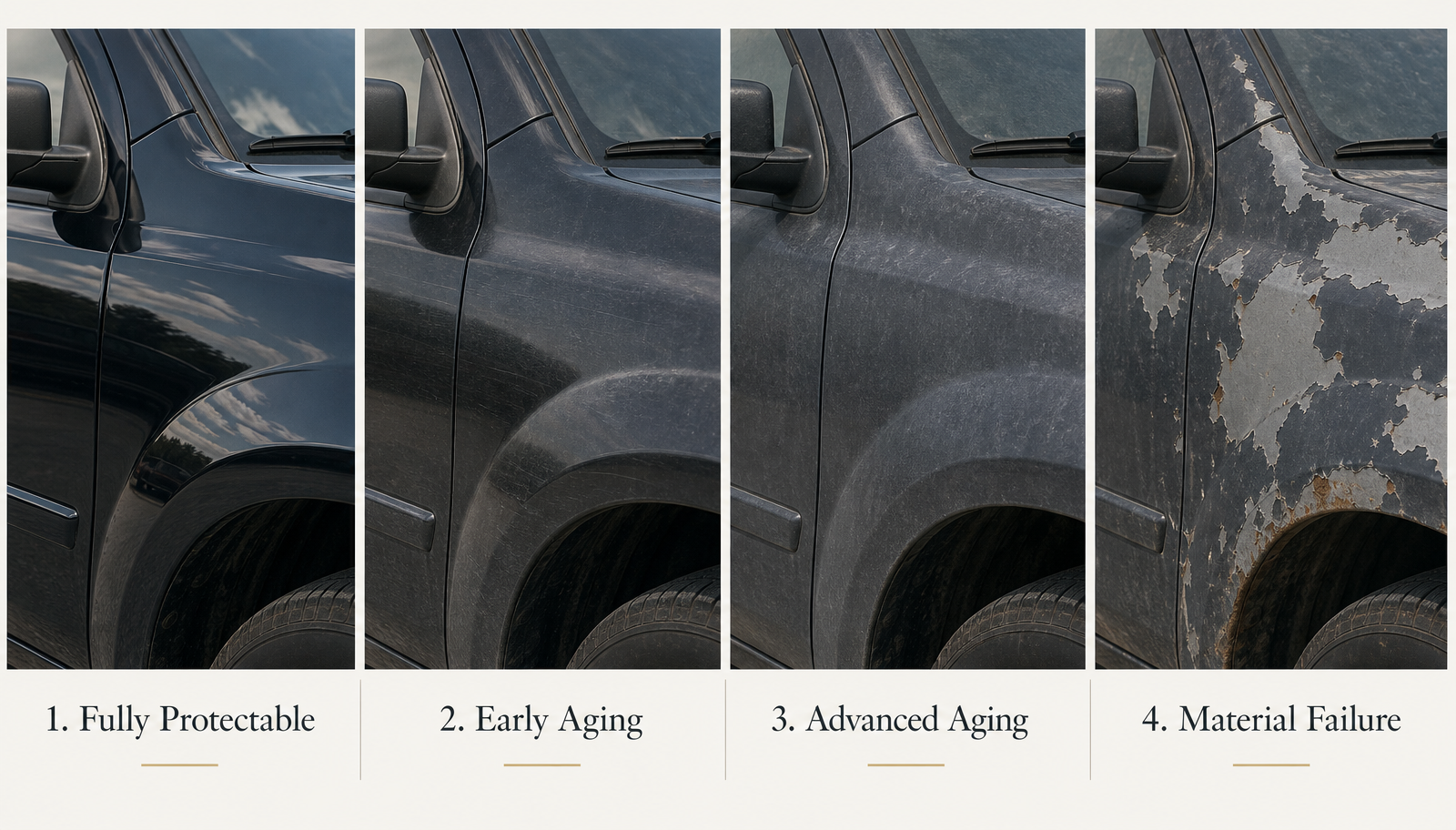
Surface Failure Is a Process, Not an Event
Vehicle exteriors rarely move from serviceable to failed in one step. Gloss becomes less uniform. Contamination bonds more aggressively. Roof finishes begin to chalk. Graphics lose flexibility. Trim fades, and routine cleaning produces less improvement. [1]
None of those changes proves material failure. They indicate that the surface is moving through a condition range that should be observed, documented, and evaluated.
The preservation window exists because deterioration is progressive.
The Preservation Window
- 01
Fully Protectable
Original finish remains intact
Primary ObjectivePreserve
- 02
Early Aging
Visible wear begins, but the surface remains serviceable
Primary ObjectiveEvaluate and intervene
- 03
Advanced Aging
Protective performance is declining
Primary ObjectiveCorrect, protect, or refinish selectively
- 04
Material Failure
The original system can no longer be preserved effectively
Primary ObjectiveRefinish, replace, or rebuild
Stage One: Intact and Protectable
At the beginning of a vehicle’s service life, the exterior system remains largely intact.
Paint retains most of its original gloss. Where present, clear coat remains intact and continues performing its intended protective role. Roof finishes remain serviceable, and graphics remain securely bonded.
Maintenance at this stage is primarily preventive. Proper washing, scheduled decontamination, routine inspection, and condition-appropriate protection help limit exposure while preserving the original materials.
This stage offers the widest range of future maintenance choices because significant deterioration has not yet narrowed the available response.
Stage Two: Early Aging
Normal exposure eventually begins producing visible changes:
• Minor oxidation
• Light wash marring
• Bonded contamination
• Slight gloss reduction
• Early chalking on horizontal surfaces
These conditions do not automatically indicate failure, but routine cleaning may no longer restore the surface completely.
Gloss can be evaluated visually and, where useful, measured instrumentally to document change and compare similar surfaces over time. [2]
Professional evaluation becomes more valuable because correction, protection, and preservation may still be realistic while the underlying finish remains serviceable.
The preservation window remains open, but it has begun to narrow.
Stage Three: Preservation Becomes Conditional
As deterioration advances, the original finish begins losing protective performance.
Oxidation becomes more pronounced. Clear coat may thin where present. Roof finishes may lose reflectivity. Graphics can become brittle. Localized corrosion may develop where protective materials have been compromised.
At this stage, the question is no longer whether every surface can be preserved. It is which surfaces still justify intervention and which have moved beyond it.
A test section, closer inspection, repair history, remaining service life, and substrate condition become more important because a uniform fleet-wide process may no longer be appropriate.
Some surfaces may still respond to paint correction, ceramic protection over a properly prepared finish, or localized professional refinishing. Others may have progressed beyond conventional preservation.
Intervention becomes more specialized, more labor-intensive, and more dependent on the condition of the underlying material.
Stage Four: Material Failure
Material failure begins when the original system can no longer perform or respond reliably to less invasive preservation.
Clear coat may separate where present. Paint systems may lose adhesion. Corrosion may advance around damaged coatings, roof finishes may deteriorate beyond serviceable condition, and graphics may crack or detach. Where appropriate, standardized tape testing can help qualified personnel rate the adhesion of an existing coating. [3]
At this stage, the fleet is no longer choosing among routine preservation options. It is choosing among repair, refinishing, component replacement, corrosion correction, or acceptance of the condition for the vehicle’s remaining service life.
The preservation window has closed because the original surface can no longer serve as a dependable foundation for less invasive work.
One Fleet, Four Different Conditions
A transportation department evaluating forty buses may find that some remain intact and protectable, others show early aging, several require individual testing, and a smaller group has already reached material failure.
Applying one process to all forty vehicles may simplify purchasing, but it weakens asset management.
The value of the four-stage framework is not the label. It is matching each vehicle to the least invasive responsible response.
Why Fleets Miss the Preservation Window
Most fleets do not intentionally neglect exterior condition. Surface aging simply loses to problems that affect today’s route, inspection, or repair order.
Exterior deterioration rarely wins the priority meeting because it does not ground a vehicle today. It simply narrows tomorrow’s choices.
Common causes include:
• Budget cycles
• Staffing limitations
• Competing maintenance priorities
• Inconsistent inspection procedures
• Gradual changes that are difficult to notice vehicle by vehicle
By the time deterioration becomes visually significant, many of the least invasive solutions may no longer be appropriate.
Condition Should Drive the Decision
A fleet should not select the service before it understands the surface.
The preservation window is a condition-based decision period, not a product category.
A useful assessment should ask:
• Is the paint fundamentally intact?
• Has oxidation progressed beyond correction?
• Is the clear coat stable where present?
• Does the roof finish continue performing?
• Are graphics still serviceable?
• Is corrosion present beneath or around damaged materials?
• How long is the vehicle expected to remain in service?
• Will the proposed intervention preserve meaningful value across that remaining period?
Understanding the condition first allows fleet managers to choose the least invasive appropriate response rather than defaulting to the most aggressive one.
Maintenance, paint correction, ceramic protection, localized professional refinishing, repair, refinishing, and replacement each have legitimate roles. The correct choice depends on the condition of the surface and the future role of the vehicle.
“The preservation window is not a product. It is the period in which the fleet still has choices.”
The Cost Curve Changes Quickly
The cost curve changes when the category of work changes.
Cleaning becomes correction. Correction becomes repair. Repair becomes refinishing, reconstruction, or replacement. Each transition introduces more preparation, labor, downtime, and uncertainty.
A fundamentally healthy surface may need only cleaning, decontamination, inspection, and protection.
A surface with advancing deterioration may require correction, localized repair, graphics work, localized professional refinishing, or more extensive preparation.
A failed surface may require refinishing, corrosion repair, graphics replacement, panel restoration, or component replacement.
The greatest cost is not always the coating or material itself. It may include:
• Vehicle downtime
• Additional labor
• Surface preparation
• Repair work
• Graphics removal and replacement
• Inspection and documentation
Protecting a surface while it remains fundamentally healthy generally preserves more options than attempting to recover it after widespread deterioration has occurred.
Building Preservation Into Fleet Planning
Exterior condition deserves the same consistency applied to other preventive maintenance categories.
A documented annual exterior-condition assessment can help identify changing conditions before they become major restoration projects. The assessment can be incorporated into annual fleet inspections, replacement-cycle planning, vehicle intake procedures, or scheduled maintenance reviews.
At minimum, document:
• Paint gloss and finish uniformity
• Clear coat condition where present
• Oxidation or chalking
• Roof finish performance
• Graphic condition
• Trim and plastic condition
• Corrosion
• Previous repairs
• Current preservation stage
• Recommended next review date
• Action trigger
• Expected remaining vehicle service life
• Areas requiring continued monitoring
Where practical, include dated photographs of the same panels or surfaces during each assessment.
Simple documentation performed consistently over time provides more value than relying on memory or waiting for deterioration to become obvious.
Condition assessment and lifecycle planning are established asset-management practices used to support safer, more dependable operations and better capital decisions. [4]
The objective is not cosmetic perfection. It is informed asset management.
Sources & Further Reading
- 1.Gupta, Ambesh; Maiti, Soumyadipta; Saini, Parvesh; Srivastava, Surabhi; Kausley, Shankar; and Rai, Beena. “Combined Concurrent Physical and Chemical Model for Accelerated Weathering Damages of Polyurethane-Based Coatings.” Physica Scripta 101 (2026), 145924.
- 2.ASTM International, ASTM D523-25, Standard Test Method for Specular Gloss.
- 3.ASTM International, ASTM D3359-23, Standard Test Methods for Rating Adhesion by Tape Test.
- 4.Federal Transit Administration, Transit Asset Management and State of Good Repair guidance.
Related Field Notes
- Asset Management6-minute read
The Condition Gap: When Exterior Wear Becomes a Budget Problem
Most fleets know when a vehicle is due for tires, fluids, inspections, and mechanical service. Fewer know when the exterior has crossed from normal aging into preventable asset decline. That blind spot is the condition gap. It is the space between early visible wear and the point where preservation is no longer simple, affordable, or predictable.
- Vehicle Preservation10-minute read
When Paint Correction Makes Sense and When Repainting Is Necessary
Not every faded or damaged finish needs new paint. This Field Note explains how fleet managers can distinguish recoverable oxidation and surface defects from coating failure that requires professional refinishing.
- Vehicle Preservation9-minute read
The Roof Exposure Problem: Why School Bus Roofs Deserve a Preservation Plan
Why school bus roofs deserve a defined preservation plan, how constant exposure creates hidden deterioration, and when reflective roof preservation belongs in the fleet maintenance conversation.
From Alpine Fleet Coatings
Managing a working fleet in Georgia?
Alpine Fleet Coatings provides mobile exterior protection, preservation, and maintenance-washing services across Georgia. When your vehicles are ready for professional exterior care, we bring the equipment and process directly to your yard.